Saturday, January 07, 2006

Shock, awe and Hobbes have backfired on America's neocons

Iraq has shown the hubris of a geostrategy that welds the philosophy of the Leviathan to military and technological power

Richard Drayton Wednesday December 28, 2005

Guardian

The tragic irony of the 21st century is that just as faith in technology collapsed on the world's stock markets in 2000, it came to power in the White House and Pentagon. For the Project for a New American Century's ambition of "full-spectrum dominance" - in which its country could "fight and win multiple, simultaneous major-theatre wars" - was a monster borne up by the high tide of techno euphoria of the 1990s.

Ex-hippies talked of a wired age of Aquarius. The fall of the Berlin wall and the rise of the internet, we were told, had ushered in Adam Smith's dream of overflowing abundance, expanding liberty and perpetual peace. Fukuyama speculated that history was over, leaving us just to hoard and spend. Technology meant a new paradigm of constant growth without inflation or recession.

But darker dreams surfaced in America's military universities. The theorists of the "revolution in military affairs" predicted that technology would lead to easy and perpetual US dominance of the world. Lieutenant Colonel Ralph Peters advised on "future warfare" at the Army War College - prophesying in 1997 a coming "age of constant conflict". Thomas Barnett at the Naval War College assisted Vice-Admiral Cebrowski in developing "network-centric warfare". General John Jumper of the air force predicted a planet easily mastered from air and space. American forces would win everywhere because they enjoyed what was unashamedly called the "God's-eye" view of satellites and GPS: the "global information grid". This hegemony would be welcomed as the cutting edge of human progress. Or at worst, the military geeks candidly explained, US power would simply terrify others into submitting to the stars and stripes.

Shock and Awe: Achieving Rapid Dominance - a key strategic document published in 1996 - aimed to understand how to destroy the "will to resist before, during and after battle". For Harlan Ullman of the National Defence University, its main author, the perfect example was the atom bomb at Hiroshima. But with or without such a weapon, one could create an illusion of unending strength and ruthlessness. Or one could deprive an enemy of the ability to communicate, observe and interact - a macro version of the sensory deprivation used on individuals - so as to create a "feeling of impotence". And one must always inflict brutal reprisals against those who resist. An alternative was the "decay and default" model, whereby a nation's will to resist collapsed through the "imposition of social breakdown".

Read more...

My favourite song from the Producers

May favourite part was when he was singing at work reminded me of myself :(

THE ACCOUNTANTS: Unhappy...unhappy..very unhappy Unhappy...unhappy... Very very very very very Very very unhappy BLACK ACCOUNTANT: Oh, I debits all duh mornin' An' I credits all duh eb'nin Until dem ledgers be right LEO & THE ACCOUNTANTS: Until dem ledgers be right LEO: I spend my life accounting With figures and such THE ACCOUNTANTS: Unhappy LEO: To what is my life amounting It figures, not much THE ACCOUNTANTS: Unhappy LEO: I have a secret desire Hiding deep in my soul It sets my heart afire To see me in this role I wanna be a producer With a hit show on Broadway I wanna be a producer Lunch at Sardi's every day I wanna be a producer Sport a top hat and a cane I wanna be a producer And drive those chorus girls insane! I wanna be a producer And sleep until half-past two I wanna be a producer And say, "You, you, you, not you" I wanna be a producer Wear a tux on op'ning nights! I wanna be a producer And see my name "Leo Bloom" in lights! CHORUS GIRLS: He wants to be a producer LEO: Sell it, girls! CHORUS GIRLS: Of a great big Broadway smash LEO: Don't forget the balcony! CHORUS GIRLS: He wants to be a producer Ev'ry pocket stuffed with cash He wants to be a producer Pinch our cheeks 'til we cry CHORUS GIRL #1: Ouch! CHORUS GIRL #2: Eek! CHORUS GIRL #3: Ooh! CHORUS GIRL #4: Oh! CHORUS GIRL #5: Ahh! CHORUS GIRL #6: Yes! CHORUS GIRLS: He wants to be a producer With a great big casting couch! LEO: I wanna be... CHORUS GIRLS: He wants to be... LEO: I wanna be... CHORUS GIRLS: He wants to be... LEO: I wanna be the greatest, grandest And most fabulous producer in the world CHORUS GIRLS: He wants to be a producer He wants to dine with a duchess and a duke LEO: I just gotta be a producer Drink champagne until I puke CHORUS GIRLS: Drink champagne 'til he pukes! LEO: I wanna be a producer Show the world just what I've got I'm gonna put on shows That will enthrall 'em CHORUS GIRLS & LEO: Read my name in Winchell's column! LEO: I wanna be a producer 'Cause it's everything I'm not THE ACCOUNTANTS: Unhappy...unhappy... So unhappy LEO & THE ACCOUNTANTS: Very very very very very very very... THE ACCOUNTANTS: ...sad LEO: I wanna be a producer Hold everything! What I am I doing here? Mr. Bialystock was right! There is a lot more to me than there is to me! Stop the world, I wanna get on! MARKS: Bloom, where do you think you're going? LEO: Mr. Marks, I've got news for you. I quit! Here's my visor...my Dixon Ticonderoga number two pencil... and my big finish! I'm gonna be a producer Sound the horn and beat the drum I'm gonna be a producer Look out Broadway, here I come!! CHORUS GIRLS & ACCOUNTANTS: Broadway, here he comes!

A Meeting with Imam Khumayni

... The night of February 8 it was announced that those invited to the conference would be addressed by Imam Khomeini at his residence in North Tehran. As soon as I heard the confirmation of what had been tentatively scheduled for any one day during the several weeks when the conference was in session, I immediately sensed the significance of this event for myself, for finally I would have the chance to measure the worth of this man directly; he would be held up to the scrutiny of my critical spiritual sensibilities, ... for although one cannot judge the inner state of consciousness of an individual, one can at least decide if there are some signs of a personal performance that would lend some credence to the nation of having achieved a state of 'liberation' from the narrow boundaries of the ego. There was just too much vengeance, blood, and doctrinal absolutism for me to finally assent to the idea that Khomeini was an 'enlightened' being, for although most reputed saints have emerged from a tradition-that is, from an organized, highly structured and antiquitous system of worship and purificatory practices-they are, when they have reached the climax of their devotion, detached from 'politics,' from heavy involvement in the surface appearance of life, from the rigid ideological warfare and clashing of opinions that dominate the more worldly individual. Khomeini's embrace-unconditionally-of harsh Islamic justice, for instance the stoning of an adulterer, the severing of the hand of a thief, and his violent denunciations of the United States and the Soviet Union-his attribution of all problems to the conspiracies of imperialism-all this seemed a little too one-sided and belief-ridden to be the representations of a human being who dwelled in the equanimity and putative bliss of the Absolute, the state of permanent freedom from the primacy of egohood. And then there were the portraits on Time magazine, the many depictions of the Imam, especially during the hostage crisis and even after the fall of the Shah: all these suggested a morbid seriousness, a humourless severity, and an apparent absence of gentleness, playfulness, or-and this is most important-compassion. The manifest characteristic of the human personality that had achieved some unity with pure consciousness was the radiant reality of love, the love that was simply the fact of that harmony, the fact of that non-separateness from and absolute cooperation with the laws of the universe that worked for the happiness of each creature. This had been the measure of all the great saints, whether Saint Francis, the Buddha, Lao-Tse, or even the Sufis I had read. Imam Khomeini was a symbol in the West of the most obdurate atavistic pride and implacable hatred. And even some Westerners with whom I had talked who had met Khomeini commented on his charisma, but in the same breath remarked at the total absence of humour or warmth in his demeanour.

Now I had the opportunity to judge for myself.

Read more...

George Bush insists that Iran must not be allowed to develop nuclear weapons. So why, six years ago, did the CIA give the Iranians blueprints

In an extract from his explosive new book, New York Times reporter James Risen reveals the bungles and miscalculations that led to a spectacular intelligence fiasco

James Risen Thursday January 5, 2006

Guardian

She had probably done this a dozen times before. Modern digital technology had made clandestine communications with overseas agents seem routine. Back in the cold war, contacting a secret agent in Moscow or Beijing was a dangerous, labour-intensive process that could take days or even weeks. But by 2004, it was possible to send high-speed, encrypted messages directly and instantaneously from CIA headquarters to agents in the field who were equipped with small, covert personal communications devices. So the officer at CIA headquarters assigned to handle communications with the agency's spies in Iran probably didn't think twice when she began her latest download. With a few simple commands, she sent a secret data flow to one of the Iranian agents in the CIA's spy network. Just as she had done so many times before.

But this time, the ease and speed of the technology betrayed her. The CIA officer had made a disastrous mistake. She had sent information to one Iranian agent that exposed an entire spy network; the data could be used to identify virtually every spy the CIA had inside Iran.

Mistake piled on mistake. As the CIA later learned, the Iranian who received the download was a double agent. The agent quickly turned the data over to Iranian security officials, and it enabled them to "roll up" the CIA's network throughout Iran. CIA sources say that several of the Iranian agents were arrested and jailed, while the fates of some of the others is still unknown.

This espionage disaster, of course, was not reported. It left the CIA virtually blind in Iran, unable to provide any significant intelligence on one of the most critical issues facing the US - whether Tehran was about to go nuclear.

In fact, just as President Bush and his aides were making the case in 2004 and 2005 that Iran was moving rapidly to develop nuclear weapons, the American intelligence community found itself unable to provide the evidence to back up the administration's public arguments. On the heels of the CIA's failure to provide accurate pre-war intelligence on Iraq's alleged weapons of mass destruction, the agency was once again clueless in the Middle East. In the spring of 2005, in the wake of the CIA's Iranian disaster, Porter Goss, its new director, told President Bush in a White House briefing that the CIA really didn't know how close Iran was to becoming a nuclear power.

But it's worse than that. Deep in the bowels of the CIA, someone must be nervously, but very privately, wondering: "Whatever happened to those nuclear blueprints we gave to the Iranians?"

Read more...

Top Ten Chuck Norris Facts

  1. Chuck Norris' tears cure cancer. But he is so badass, he has never cried. Ever.
  2. Chuck Norris does not sleep. He waits.
  3. Chuck Norris is currently suing NBC, claiming Law and Order are trademarked names for his left and right legs.
  4. The chief export of Chuck Norris is pain.
  5. If you can see Chuck Norris, he can see you. If you can't see Chuck Norris, you may be only seconds away from death.
  6. Chuck Norris has counted to infinity. Twice.
  7. Chuck Norris does not hunt because the word hunting infers the probability of failure. Chuck Norris goes killing.
  8. Chuck Norris doesn’t wash his clothes, he disembowels them.
  9. Chuck Norris is 1/8th Cherokee. This has nothing to do with ancestry, the man ate a fucking Indian.
  10. In fine print on the last page of the Guinness Book of World Records it notes that all world records are held by Chuck Norris, and those listed in the book are simply the closest anyone else has ever gotten.
  11. There is no chin behind Chuck Norris' beard. There is only another fist.
Additional Chuck Norris Facts

Thursday, December 22, 2005

Where Are All These 'Loose Women' My Pastor Keeps Warning Me About?

I've lived in Clearburg my whole life, and I've been attending services at Holy Christ Almighty Lutheran Church for about as long as I can remember. I know my Bible stories, because Mom and Dad saw to it that they raised me right. I figure I'm about as faithful of a 17-year-old high-school kid as there ever was. There's one thing I don't understand, though: It seems like practically every week, Pastor Clayman goes off again about the dangers of harlots and jezebels, and how I shouldn't allow them to tempt me away from the path of the righteous. But as far as I can tell, I've never met a so-called "loose woman." I'm starting to get really curious about where they're all supposed to be.

I'm not saying I want to associate with loose women—far from it. All I'm saying is, I wouldn't mind just getting a chance to find out for myself where these loose women might be congregating. So far, all I have to go on is Pastor Clayman's assurances that they're tempting us from everywhere. The guy really gets going with his descriptions of the painted faces, the beckoning leers, the naked, perfumed flesh undulating to the throbbing beat of secular music—but they don't match any of the women in this town in any of the numerous places I've checked.

I know plenty of women, but I don't believe any of them are "loose." There's Karen Marckell, who works down at her daddy's liquor store, for example. She wears a belt buckle that says "Born To Raise Hell," and I've heard some of the church ladies describe her as "trouble," but she appears to be a downright healthy-looking woman to me. Especially her hair—it's real pretty. I ought to know, too, because I've scrutinized every inch of her—sometimes for minutes on end. In my mind's eye, I can picture her contorting like a harlot, but whenever I talk to her, she just smiles and rings up my soda. She never even offers me reefer or makes provocative motions with her hips or anything.

There's girls at my high school that are supposed to have "bad reputations," but whenever I try and approach them, they just ignore me or call me "Geek Bundle." Here's how many times my soul has been enticed into sin: none.

I drove out to Kendall, Prior Bluff, Plovis—once all the way out to Mitchville—and I didn't have any luck finding loose women in any of those places, either.

Pastor says they've got a whole lot of them in the big city, and you can bet that when I went there for the national Youth League conference last fall, I was watching for them like a hawk. But most of the city women I saw were just riding the bus and staring straight ahead with blank looks on their faces. The last thing they seemed interested in was luring me into the sordid back alleys of vice and hedonism. I mean, they didn't even make eye contact with me, to tell the truth.

Maybe these loose women aren't as bad as Pastor Clayman says. Maybe if I just got a chance to talk to one, I could convince her to come with me to Sunday services and pray for Jesus to enter her. Maybe she'd even let me hold her hand while we prayed together. Sure, there's some risk—I admit that—but I'll bet I could probably keep her from talking me into doing anything really bad.

I'll bet I could resist a loose woman, no problem, if I could ever find one. Sometimes, I imagine myself resisting as many as three or four at a time. Abraham was commanded by the Good Lord Himself to sacrifice his own son as a trial of his faith, and Abraham almost did it, too, before the Lord stayed his hand and told him he'd passed the test. Well, if Abraham's faith was as strong as that, you'd think the least the Good Lord could do is send me one loose woman and see how I stand up in a real-life test of faith.

Just a couple of loose women, leaning lasciviously on the hood of a sports car or something, like in my cousin's hot-rod magazines, would be more than enough for me to feel my faith had been adequately proven before the Lord.

The last thing I want is to burn in the flames of perdition and retribution for all eternity like I've heard Pastor Clayman talk about until he's blue in the face every single Sunday since the day I was born. In fact, when it comes to big, long-winded speeches that really fix every detail in your mind's eye, the eternal agonies of Hell are probably the only thing Pastor Clayman talks about as much as these loose women supposedly lurking around every corner, forcing me to fight them off all day and night, continually attacking my soul with their constant barrage of temptations.

Well, maybe that's what Pastor Clayman's life is like, but mine sure as heck ain't.

Wednesday, December 21, 2005

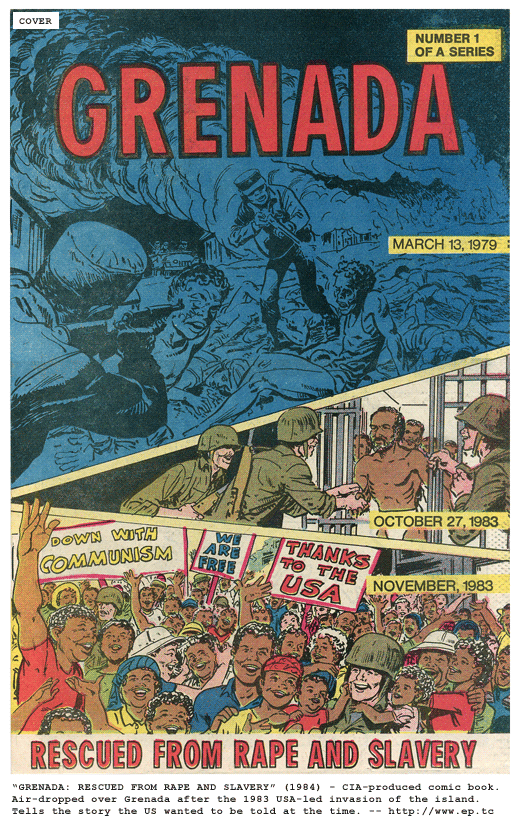
Comic psyops: CIA's Grenada booklet from 1983 invasion

The comic book gem GRENADA: Rescued from Rape and Slavery was produced by the CIA and air-dropped over the island nation after the 1983 US-led invasion.

Art Dorks

Soviet-era space-themed New Year's cards

Awesome gallery of aerospace-themed holiday greeting cards from the former Soviet Union. Link All of the cards in the linked to collection are, in fact, New Year’s cards, not Christmas cards – they bear the New Year greeting С Новым годом! (Pronounced: s’novy godom). New Year’s was the main holiday celebrated in the former Soviet Union (officially atheist), replete with a New Year’s tree and the appearance of “Dyet Moros” (Grandfather Frost) – not Santa. Christmas was banned after the 1917 revolution and not celebrated again until 1992. Also, in Russia, Christmas is celebrated by the Orthodox church according to the Julian calendar, on January 7, and was/is a much different type of celebration than New Years. (Link).

Methadone clinic comix: HOOKED!

Scans of HOOKED!, an anti-drug comic book distributed at New York City methadone clinics in 1966. Link.

Q: Is life, essentially, comic or tragic?

Emma Brockes Tuesday December 20, 2005

Guardian

Woody Allen has been playing himself for so many years now that one wonders if his personality might, at some stage, actually run out. He admits that when he is filming he grows tired of his image and, for the past few years, audiences have tired of it too. But when asked if he worries whether he might, one day, stop being funny he says, "Well, no. Because if I wake up, I'm going to be funny, because it's me. It's not that I put on a thing to do it; I wake up in the morning and I can write. I roll out of bed and I can write; I can write - that's what I do, that's me. So it would have to be a complete personality change for that to happen."

Allen at 70 looks little different to the young man who appeared in Play It Again, Sam in 1972. His agelessness is often remarked upon and it is curious; the pale, unlined face is soft-looking, like moleskin, and the eyes are wide, in the way of all creatures who spend too much time straining to see through the dark. On the evidence of our interview, Allen's public persona is a barely exaggerated version of his private self; he really does whine; he really does see the world as a tragic place; he really is amused, in a ghoulish way, by the suspension of disbelief that allows people to function in the face of their own mortality. You either like him for this or you don't; if you do (I do), then the shtick is enough to make even in the slightest of his films a joy; if you don't, he is simply horrid.

Even so, for the past decade, ever since the triumph of Bullets Over Broadway (it was nominated for eight Oscars and won one), Woody Allen films have been a little samey, have looked a little tired, which is why his new production, Match Point, benefits greatly from the fact that he is not in it. It is the first film he has shot in London and it is big and long and serious, something the audience is tipped off about early on when the lead character, played by Jonathan Rhys-Meyers, is filmed casually reading Crime and Punishment (Allen says the book "puts my movie to shame"). Although the title sounds like a made-for-TV movie, this is Allen as the sort of film-maker he has always admired, but rather defensively sent up. It tackles big, Greek themes, with a classical score, beautifully shot and shockingly concluded. The film revisits the age-old debate of character versus fate, faith versus self-determination and above all, luck; at what stage does a series of bad line calls constitute a destiny?

"I had an idea about wanting to do something about the role that luck plays in life," he says, "and that we're all terrified to face up to that. Everyone wants to think that they, you know, control their lives, or at least have some control. You like to think, you know, well, if I exercise and eat right and don't smoke, I'm going to ... But that doesn't do it. And no amount of planning can account for the big part that luck plays. I wanted to write a story that would illustrate that."

Is he lucky? Yes, he says; he must be, in some way, merely by virtue of the fact that he is successful.

"People are often not honest about it, but the truth of the matter is that you are very dependent on ... You know, when I started in show business, there were guys and girls who were as talented as me or more; and you know, one died in a plane crash. You know ... what can you ... you need luck. It's a very, very important part of your life, and you don't acknowledge that."

Read more...

Bound for Glory: America in Color

The blurb from the site: Bound for Glory: America in Color is the first major exhibition of the little known color images taken by photographers of the Farm Security Administration/Office of War Information. These vivid scenes and portraits capture the effects of the Depression on America's rural and small town populations, the nation's subsequent economic recovery and industrial growth, and the country's great mobilization for World War II. I just love this kind of thing. I find it fascinating how difficult life was for almost all the previuos generations, and how relative it all truly is. I sit as a middle class man, in luxuries many of my ancestors would never have dared dream of, and yet I hunger. I feel unentertained. I feel incomplete. Contentment with what one has is the provision of the believer. We are full, yet we're truly starving. I think that many of those who tread before us would smack us if they heard us complain. Like when I was doing ablutions at the mosque. There was this elderly Bangladeshi chap next to me. In hope of making conversation I said, "Cold eh," smilingly. He looked up at me as one would some lint. "You are young," he firmly replied. It makes me laugh to think of it. I have the softest whitest hands. Yes, these hands have never known labour. Click here for the online exhibition.

Sunday, December 18, 2005

'I do bad taste with intelligence'

Over an anarchic lunch, Mel Brooks wisecracks about everything from the new-found success of The Producers to his wartime high jinks. But the recent death of his wife, Anne Bancroft, has left him bereft. Rachel Cooke Sunday December 18, 2005 The Observer To slip briefly into luvvie parlance, Mel Brooks is what is known as a trouper. This means he always gets on with the job, come sleet or snow, a goonish smile slathered across his face (even if, in some lights, the smile does look more like a grimace). His old-fashioned trouper qualities manifest themselves in all sorts of ways. At one end of the scale, there is his determination to keep working and talking and travelling, even though it is still only six months since his wife of more than 40 years, Anne Bancroft, died of cancer. At the other end, there is his delightful enjoyment of this room, in Simpson's, an ancient restaurant on the Strand, where we are trying - and just about succeeding - to have lunch together.

Mel, and Mel's people, had hoped to bag a table at the Savoy Grill. But nothing doing. So we have come round the corner to this less swanky establishment. The carpets are busy, and the place is packed with office Christmas parties; I can hardly hear myself speak, let alone catch Brooks's hammy burr. To my left, a woman in a sparkly dress has just taken a photograph of her group (I can only give grateful thanks that her camera is back in her handbag when my guest walks in), and later the maitre d' will proffer a laminated menu for Brooks to sign, which he does, even though the Biro skids over it like a glass on a Ouija board ('Don't worry! I can do it,' he yells, gripping the pen with all his might).

But does any of this bother him? Does it hell. 'Isn't this great?' he shouts. I must look blank, because he soon says again: 'I said, isn't this GREAT?' I nod my head vigorously. His approach to dining is as wilfully anarchic as his humour. First he orders some brown toast. Having demolished this, he asks for a cappuccino. Next, a Dover sole, which he would like meunière rather than grilled. When the waiter tells him that this comes with chips, he yelps as though he has been burnt: 'No, no, no!' A compromise is found. He will have potatoes and some savoy cabbage. As for the cappuccinos, they just keep on coming; he drinks them so fast, I fear for his tongue.

Read more...

Where there's smoke ...

When the government last year downgraded it to a class C drug, the message seemed pretty clear: cannabis is harmless. Since then, there has been mounting evidence of a link between the drug and mental illness. So is it safe to skin up? Blake Morrison reports

Friday December 16, 2005

Guardian

About five years ago, Julie Lynn-Evans became aware that cannabis was not the mild and harmless drug that she had always thought it to be. Partly it was through having teenage children of her own and talking to other parents, and seeing how wiped out and catatonic kids could be after smoking "skunk", as the form of the drug now dominating the market is known. At the same time, she began to notice that a large proportion of the troubled adolescents she was seeing in her consulting room - all the boys, at least- were cannabis users. A psychotherapist with many years experience of working with teenagers, she suddenly saw links between their use of the drug and the problems that were bringing them to her, including paranoia, depression, lethargy, violence, school refusal, school exclusion and poor self-esteem. There was no scientific evidence she knew of to support her. But other psychiatrists she talked to had observed the same phenomenon and were arriving at the same conclusion.

"I'm not an alarmist," she says, "nor a reactionary. In fact, I'd say I'm one of the most liberal people I know. But I am really worried. What my generation smoked as cannabis and what today's kids are smoking are completely different. This isn't some cosy, middle-class moral panic - we're talking about kids with knives, kids in trouble with the police, kids on lock-up wards and in psychiatric hospitals. I used to get just a trickle of cases - now I've a long waiting list of kids who have lost their way. And there's no doubt that skunk plays a large part in many of the sad stories I'm asked to disentangle. It's an incredibly dangerous drug."

Earlier this year, to make her point, she told a newspaper: "I would rather my daughter took heroin." Now she slightly regrets the sound bite - "a needle full of heroin is a pretty scary idea, too" - but she sticks by the point she was trying to make: that while heroin addiction is curable, the effects of skunk on some people are not. "Once psychosis has been triggered, the effects can be permanent. I have young kids who come to see me who only get by because they're on anti-psychotic drugs. And for a small percentage, there's no way back. They've lost control of their lives and we've lost them."

Lynn-Evans and I come from the same generation, one that hit adolescence in the 1960s or 70s. Aren't her anxieties precisely those which our parents expressed when we took drugs? "Fair point," she says. "It could be that I'm turning into a reactionary old goat. But the kids who come to see me don't seem to think so. And the research to back up my hunch is in place now. There's more and more of it every week, and all the studies show the same thing: that for a significant number of young people, smoking cannabis poses a risk; and the earlier you start smoking, the greater that risk will be."

Read more...

Two tribes go to war

With supremacist 'Anglos' battling it out with 'bloody Lebs' on Cronulla beach, it looks like being a long, hot summer down under. But the reality is that Australia is no more racist than Britain, argues Germaine Greer

Germaine Greer Thursday December 15, 2005

Guardian

'We are the Sons and Daughters of the Anzacs. We cannot expect our treasonous government to protect us in these times, they are the ones that bought us to this very place. With 150,000 Arabs entering our nation 'legally' each year, it is time Australians stood up and were counted. For we are the Sons and Daughters of the Anzacs, the men who protected us from threat and invasion in years gone by. Now it is your turn, OUR turn, the guard has changed, the times have changed, but true patriots shall never be silenced."

So runs the latest communique of the commanders-in-chief of the "Anglo" side in the south Sydney beach wars, summoning me and other "Australians" to Cronulla next Sunday to do battle with the foreign invader. Under freshly invoked emergency powers, the Australian who sent it to me could incur a fine of A$5,000 (£2,130). Meanwhile, Arab-Christian and Arab-Muslim organisations are desperately trying to impose a curfew on their communities; Lebanese mothers are being asked to use their authority in the family to keep their sons at home next weekend.

The "can-Australia-really-be-racist?" approach of the British media to reportage of the battle of Cronulla is gratuitous and silly. Australia is as racist as Britain, no more, no less. Australian racism derives from the same bottomless source as British racism - from universal ignorance and working-class frustration, reinforced by an unshakeable conviction of British superiority over all other nations on earth, especially the swarthy ones. If Australia had been colonised by any other nation but the British, it would be less racist. As it is, it is dying hard.

Read more...

Suspected and Feared

Muslim Migrants after September 11th By Behzad Yaghmaian

It was a beautiful and sunny day that September 11th and I was in New York's Central Park biking when I saw the helicopters flying south. Sirens and more helicopters followed. Sensing that something troubling had happened, I headed for home.

On my way into my building, I was stopped by a harmless, mentally-impaired man, a street regular in our neighborhood. With a frantic look, he stuttered out, "Did you hear? The Arabs have attacked!" Then he said it again. "The Arabs" was what I heard as I headed for my apartment, hoping he was wrong. What could he know? I thought, only half-convinced.

By midday, of course, everyone was talking about the Muslims, the Arabs, the Middle Eastern terrorists. I remained in my room, avoiding suspicious neighborhood eyes, watching the Twin Towers crumble again and again on screen. I had lived in the United States for years, but already I feared I had somehow become an outsider -- a suspected outsider. I feared the start of a witch-hunt against people who looked like me. Some of my American friends, who had the same fears, called offering, for instance, to drive me to work the next day. "Nobody will bother you if you're with me," said one. "Stay here with us and you won't have to drive at all," said another who lived near the college where I taught economics.

Long before September 11, I had decided to write a book about the journey of millions of desperate migrants seeking in the West a life free of violence and poverty. The attacks of September 11th narrowed my focus to Muslim migrants who were now regarded as potential terrorists and a threat to national security. As the months passed and the President's "war on terror" began, I prepared for a long eastward journey of my own in order to follow Muslim migrants west in search of new homes. Expecting to be away for at least two years, I visited Quebec in May 2002 to say farewell to friends.

Early on a Saturday morning, bidding my friends in Quebec goodbye, I drove towards the U.S. border less than an hour away. Lining up behind the other cars, I reached over and unzipped the side pocket of my knapsack, got my American passport out, checked all my documents, and slowly approached passport control. A middle-aged woman with short blond hair and a blank face took my passport.

"Where are you going, sir?" she asked.

"Home. New York City," I replied.

Where had I visited, she wanted to know. What were the names of people I met? What exactly was my profession? I responded as calmly as I could. She asked me to open the trunk and remain inside my car while she searched it. I complied.

Read more...

Breakdancing Transformers Video

Friend sent me this link..... transformers....wicked.... See them dance.. click here

The sickness bequeathed by the west to the Muslim world

The Iranian president's support for Holocaust denial is a measure of how far the infection of Jew-hatred has spread

Jonathan Freedland Wednesday December 14, 2005

Guardian

There were few memorable moments in the election campaign of 2005, but there's one I won't forget. It came when I was interviewing a group of Muslim voters in Edinburgh, asking how the Iraq war had unsettled their political allegiances. One older man began telling me that he did not blame Tony Blair or even George Bush for the way things had turned out, because they were mere dupes of a more powerful force. The calamity of 9/11 was not all it seemed: the authors of that event were not the 19 hijackers, but more shadowy players, unknown even to Bush. Later, as he gave me a lift to the station, I asked who these secret powers might be. The answer was "rich Jewish people".

I told him that just as there were plenty of lies told about Muslims, so there were lies told about Jews - and that neither of us should accept either. I put the comments to one side, dismissing them as the ramblings of one man.

Again and again in recent years, I've made the same move. I've read the reports of sermons in the Arab world, denouncing Judaism and Jews, and tried to see a wider context.

So I saw the vox pop on Saudi TV asking people on the street whether they would ever shake hands with a Jew - unanimous answer: no - and guessed that perhaps this was an exceptional item, hardly indicative. I read the transcript of an interview with Basmallah, a three-year-old girl, again aired on Saudi TV, who was introduced as a "Muslim girl, a true Muslim". Here's the exchange:

Host: Basmallah, do you know the Jews?

Basmallah: Yes.

Host: Do you like them?

Basmallah: No.

Host: Why don't you like them?

Basmallah: Because they are apes and pigs.

I shuddered to read such a thing. But it was translated and distributed by the Middle East Media Research Institute, and, like others, I wondered about the group's motives: Memri was founded by a veteran of Israeli military intelligence. (On the other hand, few challenge the accuracy of Memri's translations: unpalatable though they are, the texts Memri finds are all too real.)

Read more...

Shattering Iraq

By Paul Starobin, National Journal © National Journal Group Inc. Friday, Dec. 9, 2005

Civil war. Surely this is an adjectival misnomer of the first rank. Of all of the various types of war, civil war -- that is, a violent conflict waged between opposing sides within a society -- has generally been the least mannerly and the most savage. "By nature without rules of engagement and retaliation, civil war is a cauldron of wanton and unpremeditated violence with little, if any, ideological leaven," historian Arno J. Mayer of Princeton University wrote in The Furies, his masterful account of the civil wars that followed the Jacobin revolution in France and the Bolshevik upheaval in Russia. Why are civil wars inherently brutal? Because, Mayer said in a recent telephone conversation, they are at bottom about "vengeance."

By just about every meaningful standard that can be applied -- the reference points of history, the research criteria of political science, the contemporaneous reporting of on-the-ground observers, the grim roll of civilian and combatant casualties -- Iraq is now well into the bloody sequence of civil war. Dispense with the tentative locution "on the verge of." An active, if not full-boil, civil war is already a reality. The principal combatants are drawn from the Sunni Arab and Shiite Arab communities, which together comprise about three-quarters of the Iraqi population of 26 million. In this picture, U.S.-led coalition forces tend to be viewed by "rejectionist" Sunni Arabs as protectors of the Shiites, who dominate the new, U.S.-backed, Iraqi government and who operate militias with close ties to the new Iraqi regime.

The Bush administration does not say that Iraq is in a civil war -- but then again, the administration does not say Iraq is not in a civil war. In the battle of words in Washington over defining the conflict, the White House studiously avoids any use of this ominous-sounding term; President Bush didn't use it in his November 30 speech at the U.S. Naval Academy on his strategy for "victory in Iraq." But in the White House's frankest appraisal, to date, of the situation, its new "victory" blueprint acknowledges that Iraqi Sunni Arab "rejectionists," and not Saddam loyalists or Qaeda-linked terrorists, are "the largest group" opposed to the new Iraqi government. This analysis is consistent with the civil-war paradigm of the conflict. Still, the White House prefers to talk about Iraq in the more limited, and less scary, vocabulary of insurgency and counterinsurgency.

The Pentagon, meanwhile, months ago began reviewing the question of whether the Iraqi conflict could be seen as a civil war. Back in the spring, Army Col. Bill Hix, then the chief of strategy for multinational forces in Iraq, initiated a conversation with two political science professors at Stanford University about applying the civil-war prism to Iraq. The discussion centered on the questions of how, and how quickly, a low-grade civil war can become full-blown. The Stanford duo, James D. Fearon and David D. Laitin, told Hix, who left his position in August, that civil wars have often occurred despite the presence of "foreign stabilization forces," and they encouraged him to look at past civil wars in such oil-rich countries as Algeria, Angola, and Nigeria. "I understand that by your metric, we are already in the midst of a civil war," Hix replied to the professors in a May e-mail, "but for reasons that are both operationally convenient and, I also think, valid ... I disagree."

Indeed, focusing the lens of civil war on Iraq omits some aspects of this exceedingly complex conflict. Foreign jihadists drawn to Iraq to kill U.S. soldiers as part of a project to establish a new caliphate in the Middle East are not really civil-war combatants. Still, the civil-war prism can explain a lot -- and also offer some prospective guidance. In the elections set for December 15, Iraqis will choose members of a permanent parliament. And if Sunnis participate widely, the elections could start repairing the hurts between warring factions in Iraq, and thereby reduce the level of violence. But it is also possible, and given the history of civil war, perhaps more likely, for the elections to stoke the flames. Democracy is not an antidote to civil war, because elections in fragile societies are often polarizing. In recent history, civil war broke out after contested elections in several post-Soviet republics; and in the United States, the 1860 presidential election turned out to be a prelude to civil war. Indeed, historian David Herbert Donald of Harvard famously blamed the American Civil War on "an excess of democracy."

The worrisome sign in Iraq is that political parties are already organizing principally along religious and sectarian lines. Moreover, the new Iraqi security forces, including the army, are composed of militia elements that "retain their original loyalties or affiliations," as the Pentagon acknowledged last July in a sentence buried in a generally upbeat report to Congress on "measuring stability and security in Iraq." Such units, if made combat-ready, "might very well turn these very arms against each other," notes Pavel Baev, who is a senior analyst for the Center for the Study of Civil War at the International Peace Research Institute in Oslo. So, what does history teach about how civil wars end? Baev's answer is not especially hopeful. "A military victory on one side," he replied.

Read more...

Voice Of God Revealed To Be Cheney On Intercom

WASHINGTON, DC—Telephone logs recorded by the National Security Agency and obtained by Congress as part of an ongoing investigation suggest that the vice president may have used the Oval Office intercom system to address President Bush at crucial moments, giving categorical directives in a voice the president believed to be that of God.

While journalists and presidential historians had long noted Bush's deep faith and Cheney's powerful influence in the White House, few had drawn a direct correlation between the two until Tuesday, when transcripts of meetings that took place in March and April of 2002 became available.

In a transcript of an intercom exchange recorded in March 2002, a voice positively identified as the vice president's identifies himself as "the Lord thy God" and promotes the invasion of Iraq, as well as the use of torture in prisoner interrogations.

A close examination of Bush's public statements and Secret Service time logs tracking the vice president reveals a consistent pattern, one which links Bush's belief that he had received word from God with Cheney's use of the White House's telephone-based intercom system.

Officials privately acknowledged that there is reason to believe that the vice president, as God, urged Bush to sign legislation benefiting oil companies in 2005.

"There's a lot of religious zeal in the West Wing," said a former White House staffer who spoke on the condition of anonymity. "It's possible that the vice president has taken advantage of that to fast-track certain administration objectives."

An ex-Treasury Department official and longtime friend of Cheney was asked to comment on the vice president's possible subterfuge. "I don't know. I certainly don't think it's something [Cheney] planned," he said. "I do know that Mr. Bush was unfamiliar with a phone-based intercom, and I suppose it is possible that Dick took advantage of that."

A highly placed NSA official who has reviewed the information released Tuesday said Cheney masked his clipped monotone, employing a deeper, booming voice.

Said the NSA source: "It sounded as though the speaker, who identified himself as God, stood away from the intercom to create an echo effect."

On Capitol Hill, sources are expressing surprise that Cheney, a vice president with more influence than any other in U.S. history, would have resorted to such deception.

"The vice president has a lot of sway in this administration," said a former White House aide. "But perhaps when President Bush was particularly resolute and resistant to mortal persuasion, the vice president chose to quickly resolve disputes in his favor with a half-decent God impression."

For many, the revelation explains Bush's confusion in the wake of Hurricane Katrina.

"I was very surprised by the president's slow response in New Orleans," political commentator Bill Kristol said. "The president told me that he was praying every day in his office, but had received no reply. I had no idea what he meant, but of course, it all makes sense now."

At the time of Katrina, Cheney was on a fly-fishing trip, from which he returned on Sept. 1.

According to highly placed White House sources, Bush's senior advisers are trying to shield the president from the news. Aides are concerned that too harsh an awakening might shake Bush's faith, which has been a central part of his life for nearly 20 years.

"It's hard to tell the leader of the free world that he has been the butt of an elaborate and long-term ruse," a former staffer said. "Maybe it would be easier to take if it came from Cheney's God voice."