Tuesday, November 29, 2005

No need to be afraid of us

The Muslim Brotherhood believes that democratic reforms could trigger a renaissance in Egypt

Khairat el-Shatir Wednesday November 23, 2005

Guardian

The violence that has erupted across Egypt in recent days is the result of government panic at the success of the Muslim Brotherhood - even in the rigged polls that pass for elections in the Arab world's most populous country. As the second round of voting opened on Sunday in Egypt's tightly restricted parliamentary contest, around 500 of our members were arrested at dawn and machete-wielding thugs attacked our supporters at polling stations. But the provocations of a corrupt, oppressive government - backed by the most powerful countries in the world - will not intimidate either our organisation, which has survived for 77 years, or the Egyptian people, who have increasingly come to trust us.

Despite the popularity of the Muslim Brotherhood - or rather because of it - the organisation continues to be banned in Egypt. Nevertheless, by standing as independents whose affiliation is widely known, 17 of our members managed to be elected as the largest opposition group in the last parliament.

Given the pressure for change, we mobilised to win more seats in the hope that these new elections would be more honest and free. We are committed to democracy and to respect fair election results, whatever the outcome. But we have contested only 120 of the 444 parliamentary seats, knowing that standing for more might provoke the regime into fixing the results. The first round of parliamentary elections, in which the Muslim Brotherhood won more than 65% of seats it contested despite large-scale rigging and intimidation, confirm that our movement is seen by the public as a viable political alternative. But in spite of the confidence the Egyptian people have in us, we are not seeking more than a small piece of the parliamentary cake. This decision is dictated by political realities, both locally and internationally: in other words, the possible reaction of a repressive government backed to the hilt by the US and other western governments.

Read more...

VIEW: Iraq’s economic divide —Amal Kashf Al Ghitta

The government must spare no effort in convincing poor Iraqis of the value of democracy and freedom. This will not be easy to achieve in a country where many people consider breaking the law an act of heroism. But we Iraqis have also learnt that power should not be concentrated in a few hands Everyone who looks at Iraq sees a nation divided between Shia, Sunni, and Kurd communities. But an equally fundamental division — one that has contributed as much to the ongoing insurrection as sectarian strife and opposition to the American-led military occupation — is the widening gap between Iraq’s rich and poor. When Iraq was liberated, most people, especially the poor, began to hope for a charismatic leader who would save them from the bitter reality of daily life. Raised in fear, they had no idea how democracy could apply to their society, or how human rights groups and other civic organisations could help shape the future. Soon enough, Iraq was faced with a new social divide. On one side stood people who understood how to operate in a democracy, attain power, and realise their ambitions. They learnt to speak the language of democracy, gaining money and influence in the process and enlisting independent organisations to defend their rights and privileges. On the other side, however, remains the vast population of powerless Iraqis, including widows and divorced or abandoned women with no one to provide for them and their children. For these people, democracy and human rights mean nothing. They are ignorant, poor, and sick. Victimised by an educational system that collapsed over a decade ago, they have few skills that can help them find employment in Iraq’s blighted economy. During Saddam’s reign, no effort was made to raise living standards for the poor. I have visited the huge slums of Iraq and found families living in homes with barely a roof to cover them, with insect infestations everywhere, and with raw sewage seeping under their doors. Day or night, they live in darkness. Needing nothing more than food, decent housing, and the possibility of a job, these families wait for death, dreading the cries of their starving children. When I met the women who live in those houses, they showered me with questions: will democracy give us food and houses? Will democracy stop men from beating their wives? Will it give citizenship to our children? Will it give us the right to divorce the husbands who abandon us? My answer to all of these questions was “yes”. Yes, democracy will give you the right to live in a decent house, the right to learn and work, and it will give citizenship to your children and make you equal with your men. But you have to work hard and make every possible effort in demanding your rights. They replied: “Saddam taught us for 35 years how to be jobless, silent, and fearful. What can we do now?” In these destitute areas, where most Iraqis live, people are prey to bitter temptations. Many are beyond the reach of political or government leaders. They fall easily into violence, theft, and sabotage. Poverty drives some to take money in exchange for acts of violence, abetted by the lure of a false heroism that they were not able to act upon during Saddam’s long reign. Poverty has exacerbated the trauma of Iraq’s violent history of wars and atrocities, which has desensitised people to killing. Read more....

Another day in Baghdad A&E

What happens to the victims of Baghdad's countless bombings? Ghaith Abdul-Ahad meets the doctors who battle to save them

Ghaith Abdul-Ahad Tuesday November 22, 2005

Guardian

Inside the compound of Yarmouk hospital, the mud-coloured buildings are filthy and falling apart. Smashed windows provide the only lighting along the corridors. Children touting sweets or cigarettes thread their way through piles of rubbish. Hundreds of people, some pushing wheelchairs, others supporting crouched figures - all clutching files of papers and x-rays - squeeze through narrow metal gates between the different sections of the compound.

There are the usual sort of hospital patients here: those with intestinal pains or broken limbs. But there are also Baghdad specialities: patients with car-bomb damage or mortar-shrapnel injuries or gunshot wounds.

Yarmouk, one of Baghdad's biggest hospitals, was built in the late 1970s when the oil-rich Iraqi government launched a five-year school, factory and hospital-building programme. That ambitious undertaking left Iraq with a modern and respected health-care system. But three wars and two decades later, it is in a shambles.

All the urgent cases end up in Yarmouk's emergency room - and there are plenty of urgent cases. The hospital receives most of the casualties from the west of Baghdad, the area of the city with the highest level of insurgent attacks; an area that has no-go zones for the Iraqi army and police personnel.

The ER is a big room with male and female sections divided by a curtain. Adjacent is a small operating theatre, a pharmacy and a large hall where waiting family members chain-smoke, sob and blame the Americans, the Zionists and the insurgents for the injuries to their loved ones.

In the main room, the floors and walls are tiled; the walls are filthy and covered with stains. In one corner sits a bulky, obsolete piece of equipment that is now used as a telephone table. In another corner there's a small, broken basin that the doctors use to wash their hands and cleaners use to fill buckets of water. Along one wall, there's a surface where doctors can fill in the three forms necessary for each patient, and then copy the forms into a big book. In the midst of all this, there are 12 metal hospital beds. Each is covered with green plastic sheets.

Over the past few months, I've spent what amounts to about two weeks in the ER. Each time I come, there are police cars and army pick-up trucks parked outside where you might expect to see ambulances. These are the vehicles that bring the victims from the latest scene of violence.

Early-morning casualties

Dr Omar Ta'ie is 26 and has only recently qualified; he speaks flawless English and says he listens to western pop music. As part of his ongoing medical training he is spending a year here in the ER. He does 12-hour shifts for four consecutive days, then gets three days off. He talks me through an average day.

"Our day starts busy," he says. "The first attacks happen in the morning, and patients start arriving by 7.15am. By 8am all these beds are full."

The first victims tend to be from insurgent attacks. The insurgents like to let off their car bombs and small explosives, and to carry out their assassinations, while it's still early. The idea is to catch officials and policemen either as they change shifts or while they are driving to work. Many of the victims, however, tend to be passers-by on their way to work in the early-morning rush hour.

"Around 10am, things calm down and we have a break until one in the afternoon when the biggest wave of car bombs and explosions often happens," says Ta'ie. "By that time most of the patients have to lie on the floor. And then nothing until 9pm, when sectarian assassinations flare up, mixed with a couple of drunken fights."

There are usually four to five doctors and a couple of medics assigned to each shift. After each wave of patients, two workers, dressed in blue factory overalls, come in and start collecting the plastic sheets from the beds. One of them brings a bucket of water and the other a grey rope mop, and with the sheets done, they start cleaning the floor. Sometimes they have to use a piece of cloth to remove a difficult bloodstain.

I was in ER one morning in September when we heard ambulance sirens. The doctors came from behind their counter into the middle of the room as a medic entered. He was pushing a gurney on which a girl lay unconscious. "Shrapnel wounds in her arm and chest from a mortar that fell on their house," he said.

Two of the doctors took her to the female section and pulled the curtain closed. The girl's mother, a huge woman dressed in a black abaya, her headscarf in disarray and her hair falling over her face, stood in the middle of the room wailing as a young female doctor - given the job of filling in the usual forms - tried to question her.

A few minutes later a big man ran into the room. "Where is Saneya?" He was looking for his sister. One of the doctors assured him that she was fine, but that she had needed to go to another hospital where they had specialist brain surgery equipment - "just for a routine check".

"Our biggest fear is when someone dies because then the family and relatives will start beating us," one doctor told me quietly.

What's even more frightening for these doctors is that they get casualties in from "commando" units, part of a feared paramilitary group with links to a Shia militia, which has a base a few hundred metres from the Yarmouk hospital.

One night when I was about to leave the ER there was a burst of gunfire - heavy machine guns roared at the entrance of the hospital. The doctors started running around urging patients, if they were well enough, to clear out. Moments later, a group of masked young men in army fatigues and black T-shirts burst into the ward. Two went to where people had gathered in the hallway, pointing guns at them and telling them to look away. Three others carried between them a piece of cloth in which one of their comrades, badly injured, was lying. They placed him on one of the plastic-covered beds.

"Save him," said one of the men in black T-shirts. One of the commandos took off his mask and began weeping. The others laid their machine guns against the walls and lit cigarettes, trying to stay calm.

A doctor asked me to go. "If they find you are here, they will kill you," he said. Outside, some commandos were holding up the traffic with bursts of gunfire. I crouched between cars until it was safe to go. The doctors were lucky that day; the injured commando didn't die. But twice in the past few months the doctors have gone on strike, protesting against commandos and army soldiers beating them up and kicking patients out of their beds to make space for their casualties. After each strike they get assurances from the ministry of interior that no armed men will be allowed into the ER. But it keeps on happening.

No pain relief

The doctors here work hard, and are dedicated, but resources are scarce, and things frequently feel chaotic. One afternoon when I was in the ER a man with a partially severed hand was brought in, another victim of a mortar attack. He was holding his dangling hand with his other hand; a friend in a blood-splattered white robe came in with him. Three doctors laid the injured man out on a bed, then stretched his injured arm out over a plastic garbage bin.

"Get me some anaesthetics," a doctor shouted at one of the cleaning boys. The boy dashed out of the room.

A doctor wearing blue medical scrubs, helped by another doctor, started to clean the wound. The injured man had been calm with shock, but now began to scream.

The cleaning boy came back saying there was no anaesthetic in the hospital. The injured man's friend ran outside in his blood-soaked dishdashas to find out for himself, but the doctors decided to stitch the hand back on without waiting any longer. The injured man started to wail: "Oh, imam, come and help me. Oh God."

The doctor in blue started to sweat as he tried to find the bleeding artery. The man's screams grew louder.

"I can't find the damn thing," said the doctor.

Patients, relatives and passers-by formed a circle around the doctors as they carried out the operation. A cleaner swept beneath the bed.

After some 10 agonising minutes, a more senior doctor managed to complete the operation. By the time they had finished the man lay unconscious. The anaesthetic still hadn't arrived.

Once Ta'ie took me to the living quarters where the emergency doctors spend their time between shifts. The doctors' residence is a big three-storey building on one side of a courtyard. Inside is a long dark corridor with rooms off to either side. Each room is small, 3m by 2m, with two camp beds, a small table and a chair. The walls are painted in green and are as dirty as everything else at Yarmouk. Luckier, more senior doctors, have a functioning toilet in their rooms, but the others have to share.

Ta'ie walked me to his room, which he shares with six others, on the upper floor. The corridor there was lit by holes in the wall. Broken doors lay gaping open and the floor was thick with dust and mud. The toilets stank.

The doctors' communal dining room was furnished with four plastic tables and a few plastic chairs. Three cats wandered around. "It's not all bad like this," said Ta'ie. "We have a TV and satellite dish in the reading room, [although] all the sofas are broken."

"I feel I am alone here," he said later. "If we ask the administration of the hospital why the situation is like this, they say, 'Because the minister of health is from a different sect to the hospital manager.'"

Too late to save a leg

Not all the casualties are victims of mortar attacks and car bombs. On my last day in the hospital a few weeks ago, a whole football team showed up. They wore cheap football T-shirts and shorts. They were all young men; one of them, a young man called Hassan, was lying on a stretcher with his leg wrapped in plaster. His leg was broken in two places and needed an operation, the doctor told me. "He should have had an operation by now; instead, a medic just twisted back his leg and fixed him with the plaster."

When I asked why they couldn't do the operation, the doctor told me that the specialist comes only once a week. "He has to wait for another two days before we can do the operation. I think by then it will be too late for his leg to be back to normal."

By that time Hassan was crying and screaming, holding his head with his hands and shouting at his friends, who stood around him not knowing what to do. "Tell me what is happening?" he shouted.

As the football team gathered around the doctor, trying to find out if there were any other hospitals that might do the operation, a crowd of people rushed into the room, pushing a gurney. An old man, blood soaking his shirt, lay motionless on top of it. His son stood by, holding his father's head and shouting at the doctors to save his life.

"Please doctor - try, I beg you, maybe you can save him." The doctors, knowing the man was already dead, patted the son's shoulder, telling him it was too late. "They killed him just because he is a Shia, because he loves imam Ali," wept the son.

The man was a Shia shopkeeper who lived in Jihad, a Sunni area west of Baghdad. The football team silently pushed their injured mate away. It was already past nine o'clock and the first of the sectarian violence had begun.

Tuesday, November 15, 2005

Hakim.... London's Calling

Last night I went to a Hakim concert, in London... yes that's in London, at the Shepherd's Bush Empire. I have to say it was a great chance to reconnect. Us expats, the Egyptians that have continuously wandered the earth have a very unhealthy relationship with the mothership. It's like she's our grandmother, whom we love, but that don't share many values or history with. There are many things that we respect about her, but there are too many things about her frumpy, unhip, ignorant ways that grate against are developed modern self identity. And as we are rarely willing to admit, often she embarasses us. If she's our grandmother, whom in a sense we still love and cherish, then all her people are our aunts uncles cousins and extended families. The one's we mix with on holidays, but keep absolutely seperated from our real lives. The ones that you know that they know that you know that they know.... that you are a boozing, womanizing, decadent westerner... who's clothes reveal a certain effeminateness. You are the stranger. Thing is you get older and the relationship starts to evolve. Your values change. Unlike in real life, where people pass on and there are few second chances. Rather than only exist in a life of regret as with the mortal world with Egypt you do get another chance. That if you apply wisdom, patience and compassion you can truly redefine your relationship and build something that is mutually beneficial. She needs you, and you knew that and neglected her all these years out of fear, misaprehension and shame. But what we fail to realise is that you needed her even more. That you were adrift for years, teased about your movies, and your maids, and your poverty by people that have only realised that a car isn't really just an armour plated camel and that there aren't little djinn inside the radio. So what does that have to do with hakim. A great deal. To me Hakim is Egypt (good thing no one reads this due to potential offense). He isn't like Amr Diab all buttered up in nice tight jeans and tank top as American as apple pie. Hakim is foul bil salata, sandwich ta3miya from toothless 3am Bul Bul fi warshit 3arabiyat Egypt Air. Hakim is the egypt that laughs rather than cry. That has suffered deprivation so that when he has, he wants to enjoy, sing dance and grin like a maniac. Hakim can't believe his luck because he's still there, still fighting, still going when he should have been consigned to a life of being someone else's Bilya. And when I was there last night seeing the crowds of Egyptians screaming out for their heritage, waving their Egyptian flags, singing a long and dancing with such abandon... muhagabat and non... alike. I felt joy. Even the two taxi driver types that scared the French wannabe belly dancers that I poo poohed on earlier in the night.... "Oh my Goood Becky... They're sooooo beee2a". Scored and danced the night away with the cutes little French girl I ever saw. And I was proud. But mostly proud that the deep tabla rythms that have been surging through the streets of Cairo for centuries were surging through my blood too. I was proud because I too realised that I am still Egyptian, no matter what. And because I can shake my waist better than any wannabe French belly dancer any day..... Youssef

Friday, November 11, 2005

Ahmed's gift of life

Ahmed Khatib's death was tragically unexceptional: the 12-year-old Palestinian was shot by Israeli soldiers while holding a toy gun. But what happened next was not. The boy's parents donated his organs to six Israelis. They tell Chris McGreal why their decision was a gesture of both peace and resistance

Chris McGreal Friday November 11, 2005

Guardian

For once, the circumstances of a young boy's death from an Israeli bullet are not in dispute. The army concedes that one of its soldiers shot 12-year-old Ahmed Khatib in the head during a raid on Jenin refugee camp in the occupied West Bank last week. Other Palestinian children playing with Ahmed have backed up the military's statement that he was waving a toy gun that looked, to the soldier who shot him, remarkably like the real thing.

The army apologised with unusual speed. The armed factions entrenched in the Jenin camp made no calls for revenge.

But it was the reaction of Ahmed's parents that caught everyone off guard. As life slipped away from their son in an Israeli hospital at the weekend, Ismail and Abla Khatib decided that some good could come of his death. The Palestinian family donated Ahmed's organs for transplant. The boy was in an Israeli hospital and his parents understood that their son's body parts were most likely to save people routinely spoken of as "the enemy" in Jenin. Within hours, Ahmed's heart, kidneys, liver and lungs were transplanted into six Israelis, four of them Jewish.

The move was hailed by stunned Israeli leaders as a "remarkable gesture for peace", particularly given the circumstances of Ahmed's death, and a bridge between warring communities. Ariel Sharon's closest cabinet ally, deputy prime minister Ehud Olmert, telephoned Ismail to praise his "noble gesture". The speaker of the Israeli parliament praised the Palestinian family for its "remarkable humanity".

The Khatibs say that peace and a desire to alleviate the suffering of others was uppermost in their minds. But, looking exhausted and still stunned by the twin demands of Ahmed's death and the Israeli embrace, they also speak of their decision as an act of resistance and anger. And they have found an ally in the armed men who more usually fight back by blowing up Israelis.

"To give away his organs was a different kind of resistance," says Abla. "Violence against violence is worthless. Maybe this will reach the ears of the whole world so they can distinguish between just and unjust. Maybe the Israelis will think of us differently. Maybe just one Israeli will decide not to shoot."

Read more.....

Tuesday, November 08, 2005

The Price of Oil

I don't really know what to say. I don't know how to put it. The manna from heaven that came down upon the Middle East dragging it out of obscurity so that those sitting upon it couldn't believe their luck. The poor bedouin became oil magnate, lord of the land. He walked with his head high, chest out, shopping in Harrods, driving in Rolls, and he couldn't believe his luck. And he feasted and others stood by envious of his bounty, wishing they too had this black liquid oozing from between their toes. But there was a price. People were hungry, and you were naive walking around with all that wealth. And as you feasted they came and they feasted upon you. Now we're all drowning in the muck. We're all tainted and can't escape our addiction. The ground is coming closer and all we can do is grip our seats and hope..... The two articles enclosed below opened my eyes. We are in big trouble. So Iraq Was About the Oil

By Robert Parry November 8, 2005

When Colin Powell’s former chief of staff Lawrence Wilkerson publicly decried the Bush administration’s bungling of U.S. foreign policy, the focus of the press coverage was on Wilkerson’s depiction of a “cabal” headed by Vice President Dick Cheney that had hijacked the decision-making process.

Largely overlooked were Wilkerson’s frank admissions about the importance of oil in justifying a long-term U.S. military intervention in Iraq. “The other thing that no one ever likes to talk about is SUVs and oil and consumption,” the retired Army colonel said in a speech on Oct. 19.

While bemoaning the administration’s incompetence in implementing the war strategy, Wilkerson said the U.S. government now had no choice but to succeed in Iraq or face the necessity of conquering the Middle East within the next 10 years to ensure access to the region’s oil supplies.

“We had a discussion in (the State Department’s Office of) Policy Planning about actually mounting an operation to take the oilfields of the Middle East, internationalize them, put them under some sort of U.N. trusteeship and administer the revenues and the oil accordingly,” Wilkerson said. “That’s how serious we thought about it.”

The centrality of Iraq’s oil in Wilkerson’s blunt comments contrasted with three years of assurances from the Bush administration that the war had almost nothing to do with oil.

When critics have called the Iraq War a case of “blood for oil,” George W. Bush’s defenders have dismissed them as “conspiracy theorists.” The Bush defenders insisted the president went to war out of concern about Iraq’s weapons of mass destruction and Saddam Hussein’s links to al-Qaeda, neither of which turned out to be true. Later, Bush cited humanitarian concerns and the desire to spread democracy.

Always left out of the administration’s war equation – or referenced only obliquely – was the fact that Iraq sits atop one of the world’s largest known oil reserves at a time when international competition is intensifying to secure reliable oil supplies.

Read more....

Running on empty

Jeremy Leggett explains how a bid to defuse the coming global peak-oil crisis was sidelined

Jeremy Leggett Tuesday November 8, 2005

Guardian Unlimited

History shows that James Schlesinger, a former director of the CIA, is not a man to mess with. As secretary of defence during the first oil shock in 1973, he threatened to invade the Arabian peninsula if the Saudis didn't reopen the oil pumps they had shut down in ire over the October war, thus precipitating the crisis.

In an interesting contrast with the US's current professed intentions in Iraq, Mr Schlesinger was on record then as saying: "Militarily we could have seized one of the Arab states. And the plan did indeed scare and anger them. No, it wasn't just bravado. It was clearly intended as a warning. I think the Arabs were quite worried about it after 73".

So it was with some surprise that participants in last week's oil summit in Rimini, Italy, heard Mr Schlesinger give a speech warning of a grave threat to the world economy from a coming peak in oil production.

Addressing a select audience that included oil ministers and senior officials from the oil cartel Opec, the energy watchdog International Energy Agency, and the UN, plus advocates of a premature oil peak such as the former British cabinet minister Michael Meacher, Mr Schlesinger offered a graphic analogy.

The peak-oil threat and the response to it are reminiscent, he said, of the rumbles under Vesuvius and the reaction to them of its hapless residents. "The peak or plateau is coming," he said.

Read more...

Sunday, October 30, 2005

BLACK BUSH

This is an editorial from the Daily Star....

Every time a friend or relative returns from the States, they talk about “The Chapelle Show”—evidently the funniest thing to happen to America since George W became president.

That’s “The Chapelle Show”—as in Dave Chapelle—for those of you who don’t watch television or whose remote control mysteriously disappeared during the African Champions League tournament.

Dave Chapelle is an irritant in Bush’s America, a boil on the nation’s backside. His humour is irreverent, dirty, provocative, not-at-all politically correct, and sometimes even funny. Imagine, if you will, a skit about the first black man taking a dump in a white toilet รก la Rosa Parks’ famous civil rights bus ride and you pretty much get the picture (whether you want to or not).

Of course Egypt has its own tradition of social and political comedy: the films and plays of Adel Iman, the music and poetry of El-Sheikh Imam and Ahmed Fouad Negm, the cartoons of Mustafa Hussein, the jokes of Ahmed Ragab—but none of it is, let’s say, as “politically direct” as Dave Chapelle—and none of it is pumped into millions of households on a nightly basis.

Take “Black Bush” for example, where this African-American comedian and his gangsta posse impersonate the Texan-American president and his cowboy cabinet at a press conference during the invasion of Iraq:

Reporter: “Mr. President, why are you attacking Saddam Hussein?”

Black Bush: “That nigger tried to kill my father!”

Reporter: “Mr. President, aren’t you concerned about the negative remarks of Kofi Annan and the United Nations Security Council?”

Black Bush: “U.N.? You have a problem with that? You know what you should do? Sanction me! Sanction me with your army! Oh wait a minute, you don’t have an army; I guess that means you have to shut the f*** up! That’s what I’d do if I didn’t have no army. I’d shut the f*** up! Kofi Annan? I ain’t takin’ orders from no African!”

Can we imagine the same skit? Instead of Sa’eedi f’il gama’a al-amriciyya we’d have Sa’eedi f’il riyassa starring Mohamed Heneidi, where he and his hashya in their freshly ironed galabeyas respond to reporters about regional politics:

Question: “How can we improve the situation in Palestine?”

Answer: “They should thank God and make peace with their neighbours in India.”

Question: “How do you feel about free elections?”

Answer: “Something for free?! Let’s have more of it!”

So where is “The El-Far Show”? As in Adel El-Far—for those of you who either never went to a Ramadan tent in the 1990’s, or who get very defensive when people make fun of Fifi Abdou.

Cairo is the joke capital of the world: It’s the theatre of the absurd delivered live to your doorstep every morning! Why can’t we move it from the aahwa to Orbit? We call ourselves awlad al-nukta, but when it comes to public performance we are awlad al-nakad.

South-east Asians in London have entire shows—“The Kumars at No. 42” and “Goodness Gracious Me”—devoted to making fun of themselves. Dave Chapelle does the same thing for black America.

It means they’ve arrived; they’re in on the joke. The ability to laugh at themselves is a marker of how well these groups have integrated into global culture.

Are we really that fragile? Where is our self-confidence?

Even our ancient ancestors had a sense of humour. Pottery has been found with one side depicting a traditional scene of a Pharaoh in his chariot, surrounded by his army, attacking a walled city; while the other shows the same scene except that mice have replaced the Egyptian army, cats defend the walls, and the mouse-king's chariot is pulled by dogs rearing like horses.

No doubt this was side-splitting stuff in the second millennium B.C. The point is that they all had a laugh, there were no pottery laws that threatened artists with entombment, and everybody was just a lot more chilled out.

Our comedy is fresh, biting, sexy, political and hilarious. If there’s anything we do well in this country, it’s insulting the crap out of each other. And this is perfect for prime time television. What could be closer to the give-and-take of rapid fire hip-hop culture than our very own radh? Our bawab’s wife would wipe the floor with Dave Chapelle any day of the week!

On top of all this, why should Americans have all the fun? With a president like theirs, they don’t need comedians. Some of the real life stuff the White Bush says is better then anything his black counterpart can come up with. On 10 January 2005 at a press conference at the White House, George W said: “Who could have possibly envisioned an erection in Iraq at this point in history?" Awlad al-nukta indeed.

Saturday, October 29, 2005

Ignorance in Action

Jihad and jingoism on Iran's streets Robert Tait in Tehran Saturday October 29, 2005

Guardian

Carrying a large Palestinian flag and decked out in a chequered kaffiyeh and black Arabian chador, Monir Kohandani looked every inch the committed freedom fighter and willing martyr deified by Iran's Islamic regime.

But as she participated along with thousands of others in yesterday's annual al-Quds (Jerusalem) day march - organised by Iran's ruling mullahs in a show of religious strength against Zionism - it was unclear whether she appreciated the stakes involved in the cause for which she was marching.

Asked for her views on President Mahmoud Ahmadinejad's remark that Israel "must be wiped off the map", Ms Kohandani, a 21-year-old law student, was unreflecting. "Whatever he says is right, his words are Islam's words," she said. "Israel is of no importance to Iran. We don't believe in it as a country. The word 'Israel' doesn't exist on our maps. We write Palestine instead."

Ms Kohandani's response represents the unyielding view of regime loyalists on Israel, to whose destruction Iran has been committed - at least rhetorically - since the 1979 Islamic revolution.

Read more...

Friday, October 28, 2005

Little Iranian George

My good friend Cap'n Kap felt I'm being a little unfair on Curious George Ahmedinejad. He felt that he made a strong and very sensible defence of his country's nuclear programme. Which I accept, though why any country would want to deal with the horrors of nuclear waste and how to dispose of it, though my wild guess would be Israe.... ok ... i'm doing it again.... It's late.. I'm bored and being spiteful. I'll let him speak for himself. That's the only fair thing to do.... and as i'm talking to myself really... well then that shows how fair I am.... Bill O'Reilly eat your heart out.

Iran is resolved to pursue nuclear program

Iranian president says nation has 'legal right' to nuclear energy

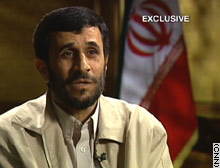
UNITED NATIONS (CNN) -- Iranian President Mahmoud Ahmadinejad fiercely defended his country's nuclear program and excoriated the U.S. government -- as well as its supporters -- in a speech Saturday to the United Nations General Assembly.

The hard-line conservative told the world body his nation has every right to operate a nuclear program for peaceful purposes, and he accused the United States of violating international nuclear obligations.

Ahmadinejad lashed out against "nuclear apartheid," saying it is unfair that some nations are allowed to make nuclear fuel while others are condemned for it. (Watch Iran's president lash out over nuclear program)

He also offered to involve other nations and private firms in Iran's nuclear energy program in an effort to prove there is no covert effort to develop nuclear weapons.

"The Islamic Republic of Iran is prepared to engage in serious partnership with private and public sectors of other countries in the implementation of uranium enrichment program in Iran," he said.

Ahmadinejad also insisted his nation does not have and will not build nuclear weapons.

"In accordance with our religious principles, pursuit of nuclear weapons is prohibited," he said, rejecting U.S. assertions that Iran is trying to build nuclear weapons under the guise of a civilian nuclear energy program.

Ahmadinejad accused the United States of violating its obligations under the nuclear non-proliferation treaty, and accused Washington of hypocrisy.

"Today, the most serious challenges is that the culprits are assuming the role of prosecutor," he argued, accusing the United States of "bullying the others while through huge media resources portraying themselves as defenders of freedom."

Israel and the Arabs: Elusive Peace

This documentary series has been on the BBC over the past couple of weeks and I have to say it was absolutely mind blowing. I mean the amount of behind the scenes access was unbelievable and interviews with all the key players. You even have footage of Shaul Mofaz and Dahlan negotiating in hebrew, which Dahlan learned in prison, and just to see the way these issues are discussed. But what is clear in all this is that the Palestinians truly have no clue. I mean they were manipulated from the beginning and everytime they did something they thought was clever and they'd boast about it, it would turn out that it was exactly what the Israelis wanted them to do. I have to say I learned to truly respect their cunning after watching it and to realise that Palestinians really are out-thought at every turn. Even when they had some opportunities to squeeze the Israelis, they'd always make the wrong choice and end up getting screwed. Moral Question: In the last Intifada less than 5,000 people have died on both sides. In 2004 alone, more than 4 millian Congolese have died in the brutal three nation conflict there. Why should we even have this Palestinian issue on our radar. Is it simply racism? I mean, the Europeans only care because the Jews are involved. And the Muslims only care because a non-Muslim is pushing them around - please note they never lift an eyebrow when its a fellow Muslim massacring their kinfolk. So it's not that Muslims are outraged by 0ppression and injustice, especially as they are oppressors and unjust, but are simly annoyed when its done to them. A bunch of blacks massacring each other and things going on that make the intifada look like kindergarden... well no one gives a toss. I think it really is about time that we start to have prespective on a world that is rapidly descending into farce. I mean Iran's own George W., Mahmoud Ahmadinejad, has been making some pretty stupid comments and still blaming all his country's woes on the great zionist conspiracy. When you have to bribe someone to get electricity to your house in Iran, is the guy Israeli. Are they Israelis that fill the ranks of the Iranian secret police? Are all those corrupt politicians and parliamentarians that don't want to even let people breathe from Tel Aviv. The whole Arab and Muslim obsession with the great Zionist conspiracy is simply a distraction from the fact that we are corrupt, unjust and rather incompetent. Israel isn't why we are the way we are..... WE ARE. Rant over... click here to see the summary of the documentary.

Pixar Short Films

Pixar has to have some of the best animation out there right now. I read a great interview with them about a year ago where they were laughing at all the animators trying to make their cartoons as realistic as possible. The true art is in drawing from real features that we recognising them but exhaggerating them in a way that resonates with people's emotions. The best example is of course the lamp and the baby lamp. Absolutely featureless, but with a few little gestures familiar to any parent-child relationship.. we immediately imbue them with all the bonds that we experience in our own filial connections. See the movies click here.

Tomgram: LeVine on Playing the Chaos Card in the Middle East

Believe me, as of yet we hardly know what chaos is. Imagine -- from the perspective of Plame Week in America -- an administration whose leading neoconservative figures believed a short few years ago that the card to play in the Middle East was indeed chaos. They then played it in Iraq, and it should come as no surprise that what they got in return was more chaos than they ever counted on.

Now, a slightly altered line-up of officials in Washington threatens to play that card again in Syria. Call it madness – or call it what passes for American policymaking. As Paul Woodward comments at his War in Context blog, "If there's one lesson learned in Iraq that the Bush administration wants to apply to Syria it's that it's much easier to bring about regime change than it is to deal with the consequences." Only the other day, reports at his Syriacomment.com blog, Joshua Landis revealed that National Security Advisor Stephen Hadley called the president of the Italian senate to ask "if he had a candidate to replace Bashar al-Asad as President of Syria. The Italians were horrified. Italy is one of Syria's biggest trading partners so it seemed a reasonable place to ask! This is what Washington has been up to." That's the "spread of democracy," Bush-style, for you. Juan Cole suggests, reasonably enough, that the obvious successor candidate in Syria would be the violently repressed Muslim Brotherhood and that then a "fundamentalist crescent" might become a reality for Washington.

In the meantime, of course, chaos has been making its dramatic debut here and, post-Iraq, post-Cindy, post-DeLay, post-Frist, post-Katrina, post-Rita, post-Wilma, post-the Miers nomination, post (later in the week)-Patrick Fitzgerald's indictments, a perfect storm of chaos is threatening to blow like some category five hurricane from Baghdad and points east back into Washington and whack the Bush administration. (Call in FEMA!) What was that saying about those who live by the sword and chaos…?

Historian and Middle Eastern expert Mark LeVine, whose blog can be found at the invaluable History News Network website, has been a student of Washington-inspired "sponsored chaos" for some time. Having just returned from the ever more chaotic Middle East, he considers the uses of chaos in Iraq and Israel/Palestine. Tom

Where Chaos Is King

By Mark LeVine

Within twenty-four hours, on October 16-17, the New York Times ran three stories about the threat increasing chaos posed to emerging, still fragile political orders in Iraq, Palestine, and the Sudan. In all three cases, the chaos afflicting these societies was described as an unintentional and negative consequence of ill-conceived policies put in place by the various governments involved: the U.S. in Iraq, Israel as it withdrew from Gaza, and the Sudanese Government as it finally tried to restrain marauding Janjaweed militias in Darfur. In no case was the chaos viewed as intentional or beneficial to one or more of the forces competing for control of these countries.

The U.S. occupation of Iraq in particular has been judged a failure by its critics almost from the start because of the chaos it has generated. Even with the approval of the constitution, "experts" are arguing that, as long as American and other foreign troops remain in Iraq, the situation "will become more chaotic," or in the words of Nebraska Senator Chuck Hagel, will continue to "destabilize the Middle East."

Read More

Thursday, October 27, 2005

'We don't need al-Qaida'

Abu Theeb is the leader of a band of Sunni insurgents that preys on US targets north of Baghdad. Last week he openly defied al-Qaida in Iraq by actively supporting the referendum. Ghaith Abdul-Ahad spent five days with him - and uncovered evidence of a growing split in the insurgency
Thursday October 27, 2005
Guardian
Abu Theeb is a tall, handsome, well-built man with a thin beard and thick eyebrows. His name is a nom de guerre: it means Father of the Wolf. He is a farmer during daylight and a commander of a mujahideen cell, a group of holy warriors, at night. He and his men roam the farmland north of Baghdad in search of prey - a US armoured Humvee, perhaps, or an Iraqi army unit. On the eve of last week's constitutional referendum, Abu Theeb, the leader of a group of Sunni insurgents, was to be found in the middle of a schoolyard in a village north of Baghdad. The school was to be a polling centre the next day. He stood flanked by 10 bearded fighters in white robes and chequered headscarves.
There were a few posters on the walls, and plastic ribbons marking out lanes where voters would queue, but other than Abu Theeb and his men, the building was deserted. The security guards hired by the referendum committee in Baghdad had failed to show up - not all that surprising an event in one of the most dangerous areas in Iraq. The local tribe, ie Abu Theeb and co, are notorious for kidnappings and executions.
Abu Theeb looked around him, a commander inspecting the field before battle. He moved with his men around the school, inspecting the adjacent streets and the back gate, looking for weak points, looking for easy access for a car bomb or an armed onslaught. The school guard sheepishly followed the entourage around, a Kalashnikov on one shoulder.
At one point, Abu Theeb grabbed a piece of paper and drew a sketch of the school, marking out where his men should be posted the next day. He turned to a short, chubby ginger-haired guy in his 30s with a big jihadi beard. "You will be the commander tomorrow," he said. "Distribute some of our weapons to the men."
The stakes were high for Abu Theeb and his men. Al-Qaida forces in Iraq - forces that are, at least on paper, allies of the Sunni insurgents - had vowed to kill anyone who took part in the referendum. But in the Sunni areas of Iraq, the people and the local Iraqi insurgents among them had a different view: they were eager to vote. There was a widespread sense of regret about the boycotting of the last elections, which left the parliament in Baghdad dominated by Shia and Kurdish parties - and left the Sunnis, who held the power in Saddam's Iraq, out in the cold. The Sunnis wanted to take part in last week's referendum; they wanted a "no" vote on the draft constitution.
This left Abu Theeb, a man who has devoted himself and his resources to fighting the Americans, in a curious position. His battle on polling day would be to secure a safe and smooth voting for his people - in a referendum organised by the enemy. In doing so he would be going up against the al-Qaida forces, and risking a split in the insurgency in Iraq.

Wednesday, October 26, 2005

The bullet holes and bloodstains are gone, but for Uzbeks life is even worse

Repression on a huge scale follows massacre of at least 500 protesters
Nick Paton Walsh in Andijan
Wednesday October 26, 2005
Guardian
Plaster covers up the bullet holes in the walls of Andijan, a city whitewashed into denial. Builders clamber around buildings, hastily repairing blast damage. Residents talk in code on the phone; the less cautious sometimes disappear.
Thick-set men in sunglasses band together on street corners, their silver saloons conspicuously tailing outsiders. The veneer of normality, here in the authoritarian state of Uzbekistan, is brittle. Ola picks at her ice cream in one of Andijan's pristine parks and says: "Everyone here has amnesia. Didn't you know?"
In the centre, the tranquil Bobur Square yields no suggestion that five months ago it was, in the words of witnesses, awash with blood. Here troops shot dead at least 500 people protesting in support of 23 local businessmen charged with "extremism" but freed in a jailbreak. The troops walked among the wounded, finishing them off with a single shot to the head, before hoarding their corpses in a nearby school.
But while locals say between 1,500 and 2,000 people died on the square, the regime of President Islam Karimov insists that only 187 criminals were killed. They have tried to recast the massacre as a measured response to a coup by Islamists, a version of events repeated daily in the Uzbek supreme court in the capital, Tashkent.
In the court, 15 of the 23 businessmen are on trial for terrorism and may be executed. They have said they opened fire first, that the US embassy helped finance their attack, and the foreign media, including the BBC, advised them. Officials have testified that the militants refused an offer of safe passage, battered their captives and began shooting each other. State TV has replayed confessions from similarly repentant "organisers".
This Orwellian conceit lapsed only once when a woman said troops had shot at people waving white flags. Makhbuba Zakirova, 33, who was interrupted by the judge, said: "Even Hitler did not do it that way."
The charade is shattered behind the closed doors of Andijan's homes. Survivors and relatives told the Guardian, the first western newspaper to gain access to Andijan since the massacre, of months of repression, arrest, and torture. Hundreds of survivors have been forced into confessing their "military involvement" to bolster the state's case.

Sectarian resentment extends to Iraq's army

By TOM LASSETER Knight Ridder Newspapers BAGHDAD, Iraq — Swadi Ghilan's two sons were dropping their sister off at high school earlier this year when a carload of Sunni Muslim insurgents pulled up and emptied their AK-47s into their bodies. In broad daylight his children were torn to pieces, their blood splashed against the windshield as they screamed and died. Ghilan is a major in the Iraqi army and a Shiite Muslim, the sect that makes up some 60 percent of Iraq's population. Now, more than ever, the grieving father says he wants to hunt down and kill not only Sunni guerrilla fighters but also Sunnis who give those fighters shelter and support. By that, he means killing most Sunnis in Iraq. "There are two Iraqs; it's something that we can no longer deny," Ghilan said. "The army should execute the Sunnis in their neighborhoods so that all of them can see what happens, so that all of them learn their lesson." The Bush administration's exit strategy for Iraq rests on two pillars: an inclusive, democratic political process that includes all major ethnic groups and a well-trained Iraqi national army. But a week spent eating, sleeping and going on patrol with a crack unit of the Iraqi army - the 4,500-member 1st Brigade of the 6th Iraqi Division - suggests that the strategy is in serious trouble. Instead of rising above the ethnic tension that's tearing their nation apart, the mostly Shiite troops are preparing for, if not already fighting, a civil war against the minority Sunni population. Ghilan's army unit is responsible for security in western Baghdad, where many Sunnis live. But the soldiers are overwhelmingly Shiite, and, like Ghilan, they're seeking revenge against the Sunnis who oppressed them during Saddam Hussein's rule. Read more....

Professor of Death

An Iraqi insurgent leader reveals how he trains and equips suicide bombers and sends them on their lethal missions

By APARISIM GHOSH

"Daddy, I want to be a martyr. Can you get me an explosive belt?"

When Abu Qaqa al-Tamimi's 9-year-old son asked for his help in becoming a suicide bomber, he was, to say the least, taken aback. "This is not what you expect to hear from a little boy," says al-Tamimi, an Iraqi man in his late 40s with close-cropped hair and a thin beard lining a round face. "I didn't know what to say." The son had even come up with a proposed target. "There was an American checkpoint near his school, and he said, 'They won't suspect me because I'm a kid, so I can walk right up to them and explode the belt.'"

Like other Iraqi parents, al-Tamimi frets about the emotional toll on his child caused by the daily onslaught of suicide bombings. But al-Tamimi bears a personal responsibility for his son's bizarre ambitions. For the past 13 months, al-Tamimi has played a crucial, and murderous, role in the Iraqi insurgency: he is one of a small number of operatives who provide would-be suicide bombers with everything from safe houses to target information and explosives. Al-Tamimi says he also acts as a guardian, religious guide and all-around father figure in the final days of a bomber's life. "Once a volunteer is placed in my care," he says, "I am responsible for everything in his life until the time comes for him to end it." Al-Tamimi is often the last person bombers talk to before their deadly mission. He is so proficient at facilitating suicide bombings that he says his own brother and sister have asked to be considered for "martyrdom operations." He gave them some basic training but advised them to find other, less drastic ways of serving the insurgency. "A suicide bombing should be the last resort," he says. "It should not be a shortcut to paradise."

Read more...

Tuesday, October 25, 2005

What the Seeker Needs: By Ibn 'Arabi In the name of Allah, The Beneficent, Most Merciful Note: What the seeker needs is also known as Kitab Kunh ma la budda minhu lil- murid. This short work was written in Mosul in 1204 in answer to the question of what the seeker "should believe in and what he should do in the beginning, before anything else."

Translations of this work have been printed on several occasions: in Turkish (by Mahmud Mukhtar Bey, 1898); Spanish (excerpts by M. Asin Palacios, 1931); and in English (by A. Jeffrey, 1962).

* * * * * *

WHAT THE SEEKER NEEDS All praise and thanks are due to Allah Most High, and may His benedictions and salutations be upon His messenger, and the progeny and companions of His messenger.

This short guide is a response to one who wishes to take the path of faith, hope, and love so that he might become complete and perfect as he was created. It was written to answer his questions about what he should believe in and what he should do in the beginning, before anything else.

O you who yearn for eternal beauty, traveler on the path of the true wish, may Allah make you successful in knowing the true way, finding it, and being upon it. May He use you and us in actions that please Him and are done for His sake. For the beginning and the end and what is in between, and success in them all, belong only to Him.

The way and means to eternal salvation and bliss is in coming close to the Truth. Allah Himself teaches us the meaning of His closeness to us. He teaches us by sending us His prophets. We say, "we believe." It is the truth. We accept and confirm it. The only thing then left for us to do is to follow the teachings and the example of His prophet.

First, you must believe in the oneness and uniqueness of the One who is before the before and after the after, who created us and everything else, and you must not associate with Him anything unbefitting the purity of His Essence. He Himself says in His divine book:

    If there were in them gods besides Allah, (the heavens and the earth) would both have been in disorder (mixing and clashing and being destroyed). (Anbiya', 22)

The wills of many creators would clash and cancel each other, not permitting anything to be or to happen. Therefore, if we and all existence exist, He -- the One and Unique Creator - exists, and He has no associates.

O you with beautiful nature and pure heart, do not debate, discuss, even talk with people who attribute partners to Allah. There is no use in trying to convince them. Even the deniers will finally concede:

    And if you ask them who created the heavens and the earth they will say, Allah. (Luqman, 25)

They as well will finally admit an unknown force as the initial Creator of the creation - but they will add to Him further creators. The difference between them and the believers is that they suppose that others, among the created, are also able to create. You do not have to prove to them the existence of Allah. Let them prove, if they can, the existence of His associates.

This is sufficient advice for you on the subject of professing the oneness of Allah. Time is valuable: you cannot be careless with it. If the mind has reached a state in which it is free from doubt and the heart is safe and secure, it makes no sense to disturb this peace with superfluous proofs.

The second matter of importance for one who wishes to learn is the belief that Allah Most High is free from all resemblance to anything visible or invisible in the creation. He is free from all defect.

There are some who, wanting to see the image of their Creator, err, and liken Him to a human being. Let His own words be your guide in this. He says:

    Nothing is like Him.... (Shura, 11)

Any thought, any word, any qualiy or attribute not corresponding to this principle is a falsehood, unworthy of the Divine. Therefore seek no further than the fact that none resemble or are like Him. That is His reality. This is also confirmed by the declaration of His messenger, who said, "At the beginning was Allah, and none with Him." The ones who followed him added to this statement, "It is now as it was." As it was before the creation, it is after the creation. From the time when matter was hidden under the veil of nonexistence and there was no form, nothing has been added or subtracted. Though He has created the creation, still there are none like Him. Nothing is like Him. Nothing is Him, but everything is from Him. The divine word that He is without likeness cancels all other thoughts, claims, and interpretations.

You must also accept, and believe, even if you do not understand, the allegorical verses of the Holy Qur'an and the ambiguous statement of the Messenger of Allah concerning the unity and the ultimate cause, as well as all the declarations of the prophets which have come to us unaltered. You must consider that the significance of these words is a part of divine knowledge and that as such, you accept them. The monumental meanings of these holy expressions are for the understanding of people who are close enough to Allah to be able to see His beautiful attributes.

There is no better proof of the perfection of the Divine, who is self-existent and whose existence is a necessity for the existence of all else, than the holy verse:

    Nothing is like Him....

Allah declares with this verse His being, His essence, His divine nature, His limitless greatness, His glory. So write in your heart and mind this principle, this foundation of faith, and believe in Allah's prophet and the message that he brought from the Divine Truth, and in Allah's orders and justice. Furthermore, have faith in the true declarations of all the prophets known and unknown. Love their companions; accept the truth of their mission. Do not speak against them. Do not value one over another. Think of them with terms of praise, as they are described in the Holy Qur'an and in the words of other prophets, which can only be the truth. Show respect, as did the prophets, for the character that distinguishes the perfect man, and for holy places. Accept and believe in the deeds and the words of the saints, even though you may not understand their state and the miracles attributed to them.

Look upon the whole creation, and above all, mankind, with good will - accepting, approving, forgiving, serving, loving. Make that your nature in your dealings with the world. Listen to your conscience. Cleanse your heart. In that clean heart, keep up prayer for your faithful brothers. Help and serve, as much as you can, the people who hide their misery, who are content with their poverty, the travelers on the path to truth. Do not attribute to yourself virtue, goodness, and graciousness because of your service to the creation. Consider that you owe other people thanks for having humbly accepted your help. It is incumbent upon you to lighten the load of those who are burdened. If people whose pain you have helped to alleviate cause you pain in return - if their responses, their ways, their habits are dark and cast shadows upon you - show patience and forbearance. Do not forget that Allah says:

    ...surely Allah is with the patient. (Baqara, 153)

Do not spend your life in empty endeavors and your time in idle talk. Instead, reflect and remember Allah, read the Qur'an, guide the misguided to the enlightened path. Help others leave evil and turn to doing good. Mend broken friendships. Help others to help others.

Find the right friend, who will be a support for you, a good travelling companion on the path of truth. Faith is a seed. It grows into a tree with the beneficent watering and sunshine of faithful friends. Beware of being close to those who do not discriminate between the faithful and the unfaithful - not knowing either faith or the faithful, they do not care about them. They are either strangers to or enemies of the truth in which you believe.

Look for a perfect teacher who will lead you on the straight path. In your search for a guide, be sincere, because sincerity distinguishes the true seeker. It is certain that if you cling to sincerity and truthfulness, the Lord will manifest His attribute of the Ultimate Guide upon you and will guide you to a perfect teacher. Sincerity in the seeker is such a blessing that when it is present, Allah will even turn the accursed devil himself and the seeker's personal devil, his ego, into angels of inspiration serving him. Sincerity is such a catalyst that it turns lead into gold and purifies everything it touches.

A matter of the greatest importance, one of your greatest needs, is to be sure that the morsel of bread you put in your mouth is lawful. Lawful sustenance, the lawfulness of all you enjoy in this world, is the foundation of your faith. It is upon this foundation that your religion can be built.

To advance in this path, in the footsteps of the prophets (peace and blessings be upon them), you have to be light - light in worldly goods, light in your concerns about this world. An unmistakable sign of the heaviness that will prevent you from advancing is to be a burden on people. Neither be a freeloader nor let others carry your load. Particularly, don't accept goods and favors, either for yourself or for others, from people whose hearts are dead, submerged in the sleep of heedlessness.

In what Allah permits you to gain as your sustenance - in all your actions, behavior and words - fear Allah. Do not seek comfort and luxury, especially when you have not worked hard for it. Lawful sustenance is obtained by working harder than is demanded of you. A clear sign of the lawfulness of one's gain is that it will not permit you to be either stingy or a spendthrift.

Take care, since if the love of this world takes root firmly in your heart, it constricts your heart, and it becomes exceedingly hard to pull it out and throw it away. This world is a trial ground; don't seek comfort and riches in it. Eat less. That will leave more space in your heart and will increase your desire to pray and be obedient It will make you more active and less lazy.

Cleanse and beautify your days and nights with worship. The generous Lord asks you to His presence five times a day. Do your prayers at the times He calls you, five times daily, and at each prayer make an accounting of your actions since the last prayer. It is to be hoped that only good deeds and actions befitting a Muslim are done between the times of prayer.

Most people complain that this world, their work to secure their sustenance, and their work as householders for their families, take time away from their worship. Know that work done heedfully, with consideration for others, in accordance with proper behavior, for the pleasure of Allah, is also worship.

Allah has blessed you with intellect, knowledge, profession, strength, and health. All grace and power are due to Him. Use these to gather as much of your sustenance as possible in the minimum of time. If possible, secure in one day your week's sustenance. Take the example of Ahmad al-Sabti, a prince, the son of the 'Abbasid caliph Harun al-Rashid. He used the maximum of his talents and strength and effort and worked exceedingly hard as a manual laborer on Saturday. With what he earned in one day he was able to live a whole week. He dedicated the remaining six days of the week to working for Allah and worshipping Him.

After you perform your morning prayer, stay with your Lord until sunrise, and after your afternoon prayer stay in His presence until sunset. These are two periods of time when spiritual powers and enlightenment flow in abundance. Keep your heart tied to Allah in humility and in peace.

There is great virtue and merit in performing extra worship of twenty cycles of prayer between the afternoon and evening prayers, and between the evening and night prayers. Perform extra prayers of four cycles just before the noon prayer, after and just before the afternoon prayer, and after the evening prayer. Perform another ten cycles of prayers in sets of two after the obligatory night prayer, and the three cycles of closing prayer, witr, as the last worship of the day.

Do not sleep until you are unable to stay awake. Do not eat until you are hungry. Dress only to cover your body and to protect it from cold and from heat. Make it a habit to read from the Holy Qur'an every day. When you read, hold the holy book with respect. Keep it in your left hand at the level of your chest, and move your right hand along the words you read. Read aloud, but just loud enough that you can hear your own voice.

Read without haste, slowly thinking of the meaning of each word. Wish for divine mercy and beneficence when you come to the verses that inspire His mercy. Take warning from the verses of admonition, and when reading them, promise your Lord your determination to act upon His command, repenting, taking refuge in His mercy, seeking salvation. When you read verses describing the praiseworthy qualities of the truly faithful, think of your own qualities. Be thankful and praise Him for your good qualities, and feel shame for the qualities missing in you, so mat you may hope to find the character of the faithful in yourself. And when you read about the faults of the nonbelievers and of the hypocrites who hide and distort the truth, think about whether you are also afflicted with such faults. If you are, try to stop them, to chase them away, to eliminate them. If you do not have them, take refuge in Him, be thankful and praise Him.

What is essential for you is to be heedful at all times, to be attentive to what comes into your mind and your heart. Think about and analyze these thoughts and feelings. Try to control them. Beware of the wishes of your ego, settle your accounts with it.

Have conscience, shame, in front of Allah. That will be a motivation to make you heedful. You will then care about what you are doing or saying or thinking, and the thoughts and feelings that are ugly in the eyes of Allah will be unable to settle in your heart. Your heart will then be safe from wishing acts not in accordance with Allah's pleasure.[1]

Give value to your time, live in the present moment. Do not live in imagination and throw your time away. Allah has prescribed a duty, an act, a worship for your every moment. Know what it is and hasten to do it. First perform the actions He has given to you as obligations. Then do what He has given to you to do through the example of His Prophet. Then take on what He has left you as voluntary, acceptable good deeds. Work to serve the ones who are in need.

Do everything you do in order to come close to your Lord in your worship and prayers. Think that each deed may be your last act, each prayer your last prostration, that you may not have another chance. If you do this, it will be another motivation for becoming heedful and also for becoming sincere and truthful. Allah does not accept good deeds done unconsciously and insincerely as readily as deeds done in consciousness and sincerity.

Cleanliness is an order of Allah. Keep your body and your inner self clean at all times. Whenever you make an ablution make two cycles of prayer following it, except when you have to make an ablution at times when praying is not permitted: at sunrise, at high noon, and at sunset. Friday is an exception to that rule; it is permissible then to pray at high noon.

Above all, what you need is high morals, good character, proper behavior; you must identify your bad features and rid yourself of them. Your relationship to whomever you come into contact with must be based on the best of conduct - but what this means may vary with conditions and circumstances.

Whoever neglects a single item of good behavior is considered to have bad character. Men are created different from each other. Their levels are different. Good behavior and character are also in different levels. Behavior is not a form. It is not to act in the same way on every occasion towards everyone. You have to consider each case, each person, in accordance with the circumstance and. the need of the person. A good rule to remember is that if a thing is done to bring salvation, truth, comfort, and peace to others, to oneself, and to as many people as possible, protecting them, eliminating pain and hardship, it is good behavior - on condition that it is not done for personal benefit, but for Allah's sake. Is not man the servant of Allah? Are not his life and his deeds dependent on divine predestination? He is in a frame whose limits he, cannot leave. His will, his freedom of choice, his destiny written on his forehead, are in the hand of the All-Powerful upon whom all acts, all moves depend.

Proper behavior is the means by which an intention becomes a good deed. Therefore it is the greatest capital in the hand of the seeker. The proof is the word of the one who was brought with the most beautiful character, the last prophet, Muhammad (peace and blessings be upon him), who said, "I have been sent to perfect good behavior."

Allah says in the Holy Qur'an:

    And the recompense of evil is punishment like it, but whoever forgives and amends, his reward is with Allah.... (Shura, 40)

The religious law says that you may choose to demand your right or you may choose to leave it. Choose to leave that which is due to you and forgive, instead of punishing, so that you will be counted among the compassionate, the peaceful, the righteous, whose rewards are promised by Allah.

It is also within good behavior to be angry and to seek to punish when this is justified by the religious code. Anger and its manifestation are one of the great sins if aroused by wrongs done to you personally. But it is permissible and right and a part of correct behavior and good character to become " "Use of something done against Allah and His divine precepts, to manifest it, and to fight for Allah's sake. It is best to separate yourself from people who do not believe in what you believe, who do not do what you do, and who are against your faith. Yet at the same time you should not think badly of them or condemn them for what they are. Your intention in ignoring them should be that you prefer the company of believers. Spend your time in remembering, glorifying, and worshipping Allah instead of being with them. Treat well those who are dependent upon you: the people who work for you, your children, your wives and husbands, your mothers, sisters, and friends, the animals in your care, the plants in your garden. Allah has given them into your hands to test you. You are in His care. Treat the ones in your care as you want the One in whose care you are to treat you. The Messenger of Allah says, "All of creation are Allah's dependents." He has left a few of His dependents, such as your family, in you hands. That is why His Messenger (peace and blessings be upon him) says that the one who is best loved by Him is the one who is best towards his dependents. Show love, compassion, delicacy, generosity, and protection towards those who depend on you - and in fact, to everyone. If you wish His compassion and protection, remember that you yourself depend on the One, the lord and owner of all and everything.

Teach Allah's words in His divine book and the good behavior of Islam to your children. Secure for them conditions in which they can exercise what you have taught them. Do this without expecting any return from them. From the very beginning, teach them to bear difficulty, to have patience, to think. Do not place in their hearts the love of the world. Teach them to dislike the things of this world that will render them proud - luxuries, beautiful clothes, delicacies, excess of ambition - because all these, if obtained, will be subtracted from the good due them in the hereafter. Let them not get accustomed to good things; break their habits. Beware that this, which may seem austere, should not bring forth in you the ugly character of miserliness towards your children. Do it in respect and attachment to your religion.

Do not seek to be close to the heedless, to the ones who are slaves to the desires of their flesh. They take hearts away from the light of truth and throw them into the dark hole of heedlessness, as they did with their own hearts. If you are placed with them in the same time and space, then face them and advise them. If they turn their backs on you, it is because they do not know their fronts from their backs. Do not stab them in the back. Be the same way to them whether they turn their faces to you or their backs. Then they may like and respect you and perchance they may be attached to you and follow you.

Do not be satisfied with your spiritual state; advance. Advance ceaselessly, without interruption. With firm intention pray to Allah, the Ultimate Truth, to bring you from the state in which you are to a state beyond it. In every state, in every move, while doing a thing or while being inactive, be sincere and truthful. Be with the Ultimate Truth. Do not ever forget Him. Feel His presence always.

Learn to give, whether you have plenty or little, whether you are happy or in pain. This is a proof of your faith in Allah. Try to satisfy the needs of the needy. This is an affirmation that Allah has assigned everyone's sustenance and nothing will change it. This is a proof of your trusting in Allah.

A miser is a coward. The accursed Devil whispers in his ear that there is no death, that he will live a long time; that the world is hostile; that if he gives he will be left destitute, dishonored, and alone; that he should not be fooled by the plenty that he now has, for no one knows what will happen tomorrow. Worse still, if the miser has little, the devil tells him that soon he will have even less. No one will help him; he will be a load on others and will be detested. He has to look after himself. If these evil imaginations capture the heart one may be led to he edge of hellfire. On the other hand, the ones who give their ears to Allah hear His blessed words. Allah says in the Holy Qur'an:

    ...and whoever is saved from the miserliness of his ego, these it is that find salvation. (Hashr, 9) ...whoever is miserly is miserly to himself. (Muhammad, 38)

The final warning is:

    If you turn back (on the path) He will bring another people in your place. (Muhammad, 38)

That is to say, after having been taught and after having been brought to the path of faith, if you begin or continue to be a miser, you may lose your place, your level, and Allah's favor. Someone else, who is generous and believes in Allah's generosity, will be brought in your place.

The one who is niggardly has not realized the terrifying meaning of Allah's words:

    Destroy their riches and harden their hearts. (Yunus, 88)

This is the curse of the prophet Moses (peace be upon him) upon the Pharaoh. When Allah willed the destruction of Pharaoh and his chief, the prophet Moses (peace be upon him) prayed to Allah, the Absolute Judge, for them to be cursed with miserliness. With the effect of this curse the Egyptians were afflicted with miserliness and envy. The poor and the weak died of hunger and Allah judged the Pharaoh and his followers and punished them because of their miserliness.

The ones who are cursed with stinginess do not listen to the words of Allah's messenger (peace and blessings be upon him), who says, "Allah has two angels next to Him who pray every morning, 'O Lord, increase Your bounties upon the ones who give, and take away what they have from the ones who keep it!"'

When Hadrat Abu Bakr (may Allah be pleased with him) wished to donate all that he possessed and brought it to the blessed presence of our master, the Prophet of Allah asked, "What have you put aside for he care of your family?" He responded, "I leave them in the care of Allah and His messenger." When Hadrat 'Umar (may Allah be pleased with him) brought half his fortune to donate and was asked the same question, he answered, "I have left half of my goods for the sustenance of my family." The prophet of Allah told them, "The difference between you two is in accordance with your response to my question "

The one who gives from his sustenance attracts; a more than he has given from the Ultimate Sustainer. The miser, in addition to his sin of miserliness, accuses Allah Most High of stinginess and prefers and trusts his miserable goods over the generosity of his Lord. This is the unforgivable sin of attributing partners to Allah and may cause one to be rejected from Allah's mercy and lose his faith, may Allah protect us.

Therefore, spend from what Allah has given you. Do not fear poverty. Allah will give you what He has promised, whether you or everyone asks for it or does not ask for it. No one who has been generous has ever perished in destitution.

If you wish to find the truth and have Allah's pleasure and support in it, then avoid being negative and control your temper and anger. If you cannot stop anger, at least do not show it. When you do this, you will please Allah and disappoint the devil. You will begin to educate your ego and straighten and shorten your path. Anger is a result and a sign of the ego not being under control, like a mean wild animal untied and uncaged. As you hold your temper, it is as if you put a bridle on its head and barriers around it. You begin then to tame it, teach it how to behave, to obey, so that it cannot hurt others or itself (because it is a part of you).

When this discipline reflects from you, revealing someone who can control his temper and hold his anger, your adversary will be calmed. You will not be reacting to his provocations. You will not be punishing him or responding to his negativity, but ignoring it. This is more effective than punishing him. He may be led to see the reality of his acts, to realize what is fair, and to confess his faults.

Give heed to this advice and make it a habit. If you do, you certainly will see the positive result and the rewards here and in the hereafter. You will be the winner on the day when your deeds will be weighed. That is the greatest reward and the greatest grace that you will receive. For if you hold your temper, the All Just will also hold back His punishment for your sins, which are punishable by His divine wrath. Your forgiving will be rewarded by His forgiving you. What better benefit may one expect for effort in bearing hardship caused by your brothers and sisters in faith?

Allah will treat you the way He has ordered you to treat others. So try to assume the good qualities of being just, peaceful, helpful, gentle, and loving. Persist in these qualities; act with them. You will see that this character will spread from you to others around you, creating harmony, mutual love, and respect. The Beloved of Allah, our master the Prophet (peace and blessings be upon him), orders us to love each other, to be in a continuous loving state. He repeats this in so many ways, in so many statements. To leave anger, to replace it with bearing hardship, with forgiving, with caring for the one who causes the hardship, is one of the cornerstones of the foundation of love.

* * * * * *

Open your heart in order to receive divine benevolence. A benevolent heart becomes the mirror in which Allah's favors are manifest. When the divine favors manifest and come through you, when you feel His presence, you will feel shame at your improper actions. This will cause both you and others to have conscience. Thus your benevolence will protect you and others from sin.

When the archangel Gabriel asked our master the Prophet (peace and blessings be upon him), "What is divine benevolence?" The Last of the Prophets answered, "To pray and glorify Allah as if you are in His presence, as if you see Him." Reverence reflects in the heart of a believer who has reached the level of praying as if he sees Allah.

Then our master the Prophet continued, "For if you are unable to see Him, He certainly sees you." The one who has reached that level of realization of divine benevolence will have conscience. He will feel that gaze of Allah upon him and will be ashamed to sin. The Prophet (peace and blessings be upon him) said, "Conscience is total good." If a believer has conscience, he is aware of what he is doing and he cannot do wrong; Men a heart is filled with conscience, the possessor of that heart encounters no harm either in this world or in the Hereafter. The sign of a man with conscience is his lack of arrogance and self-importance. He never oppresses or tries to dominate others. May you also reach the level of benevolence and have conscience, and may you have the strength and foresight to try to attain it.

* * * * * *

Wake before sunrise, remember Allah, and repent. When repentance follows sin, it erases it The sin disappears as if it never happened. When repentance follows a benevolent action or prayer, it is like light upon light, grace upon grace. To remember Allah and to praise Him unifies the heart when it is scattered all around - like a mirror broken into a thousand pieces - and mends it, makes it into one, and turns it towards the One. Then all trouble leaves the heart, and it is filled with the joy of the One whom it remembers.

When your heart is filled to the brim with remembrance, then read the Holy Qur'an. When you read, reflect upon the meaning of what you have read. When verses remind you of His oneness and of His being without likeness and free from all defect, praise Him. When you read verses describing His blessings, bounties, generosity, and love or His wrath and punishment, take refuge from Him in Him and beg for His mercy. When you hear the parables about past prophets and their people, take heed and draw lessons from what happened to them. There are infinite meanings within the verses of the Holy Qur'an, within every word - changing with your states and levels, knowledge and understanding. Therefore you cannot possibly be tired, weary, or bored in reading them.

* * * * * *

Try to undo the knots of your persistence in sinning. Knot over knot ties you up. How are you going to save yourself? You will need the help of the one who tied those knots, your own self. Talk to it, reason with it. Tell it: "O temporal flesh, you resent listening to reason, but listen. Are you sure, as you inhale, that this is not your last breath? Allah knows best, but the next breath may be your last in this world to which you are so attached. Death will seize you by the throat; yet you persist in piling wrong upon wrong, sin upon sin. The Ultimate Judge warns the ones who persist in sinning with such punishment that mountains of rock cannot bear it. How then can you, flimsy as a straw, imagine that you could bear such horrible torments? Do not turn your back on me One who created you. Face Him and repent. Do it now, without delay, for you do not know when death will break you in two."

    And repentance is not for those who go on doing evil deeds, until when death comes to one of them he says, "Now I repent ...... (Nisa', 17)

Say to the self: "Indeed, after the aura of death has rendered you prostrate and life is fading away, if you can remember at all and repent, that repentance will not be accepted by Allah. The Prophet whom He sent as a mercy upon the universe said that though Allah accepts your repentance until the time when your breath is being choked out of you, at the moment of your death throes it is too late. Death comes without: warning - to some while eating, to some while drinking, to others while sleeping with their wives, to others in deep sleep from which they do not awake. Whoever, before that, has not turned from falsehood to truth, has not repented but persists in sinning, will fall into the abyss of death."

Talk this way to your self. Try to discipline and educate the desires of your flesh. As. they are persistent in sinning, be persistent in convincing them to stop sinning. If you keep warning your lower self, with the help of Allah the knots binding your heart will be untied. That is the only way to be saved.

* * * * * *

Fear Allah both in your actions and deep in - your heart and thoughts. Fear of Allah is the fear of Allah's punishment. Whoever truly fears the warnings of torment of the Absolute Judge cannot but act in accordance with the pleasure of the Creator and seek the right over the wrong. The Owner of the Final Word Himself said:

    ...and Allah cautions you against His retribution.... (Al-Imran, 27) ... and know that Allah knows what is in your minds, so beware of Him.... (Baqarah, 235)

The fear of Allah is a protection, the thing that guards you from harm. Allah's protection is the strongest of all armor, of all fortifications; no harm can penetrate it. That is what divine fear secures for you. The Prophet of Allah, whom He sent as His mercy upon the universe, himself took refuge in his lord. Praying to Him, he said, "I take refuge in Your pleasure, in Your beauty, in Your gentleness, from Your wrath and Your strength. I take refuge in Your divine mercy and compassion, from your punishment. I take refuge in You from You."

Seek, learn about, and imitate K beneficent acts of your Creator that manifest all around you. Protect yourself against divine wrath with acts and deeds in accordance with Allah's pleasure. Whatever act, whatever thing, whatever path is under the shadow of doubt and fear, do not come close to it. Leave it. Know that knowing your Creator and obeying Him is the only path that will lead you to peace and felicity. Revolt and selfishness are a dead end. Only by gaining the divine consent can you save yourself from your Lord's wrath. Only be entering the straight path can you get out of the abyss of that dead end; only by actions proper to paradise can you keep away from the fire. Allah says:

    Fear Allah... and fear the Fire. (Al 'Imran, 130-31)

With the fear of Allah, rise away from fire and towards felicity.

* * * * * *

While you persist in sinning and stubbornly refuse to see your errors, why are you so proud that Allah treats you with patience, kindness, and generosity in spite of your sins? Is it that you are fooled by what the devil whispers in your ear, saying, "If it weren't for your sins and your revolt, how would Allah manifest His infinite mercy, compassion, and generosity?" Don't you see how irrational that evil teaching is? Would it be less merciful and beneficent for the Owner of Infinite Wisdom to prevent His servant from opposing His will and pleasure?

Then the devil may whisper in your ear again: "You have no hope of attaining the level of benevolence of those who are born with good character and obedience. They have come to this world and shown their obedience to the will of Allah, gathered their Lord's mercy and beneficence in this world, and left it. The real mercy, generosity, and kindness of Allah will be manifest in the Hereafter on the Day of Judgment, Men He judges His disobedient servants who need of His mercy."

Only someone who has lost his senses could believe in and be deceived by such thoughts. Protect yourself against such temptations and tell your devil: "What you say about Allah's infinite patience and generosity towards His servants is true. Indeed, if there were no revolt, disobedience, and sin, we would not see the manifestation of His divine attributes. So many examples are related to us in the holy books and statements. But you, evil one, are using the truth for your own purposes - so that Allah's mercy be manifest, you encourage me to sin! You are trying to make me revolt because Allah is patient and kind.

"You ask me to test Allah's mercy and beneficence. How do you know, O accursed one, that I am of those who will be forgiven? Indeed Allah forgives whom He wills and punishes injustice whom He wills. How do I know to which party I belong? All I know is that I am full of sin. And just as I was left in this world without the ability to repent and ask His forgiveness, He may well refuse me His mercy before I enter hell and punish me with the fire. Although one dies as one lives, and sin is the messenger of disbelief, if I am fortunate and give my last breath as a believer, then He will purify me in hellfire and take me out and give me peace in His mercy.

"If I knew for sure that there were no day of reckoning with my sins, that there were no punishment, and if I were certain that I would receive divine absolution, I might have considered your twisted reasoning. Even then, it would be no better than admitting foolishness, for it is certainly an unforgivable behavior for a servant to test the patience of his Lord.

"On the other hand, even if I were certain that I would receive divine punishment, the proper thing for me would be shame and thankfulness for His delaying His punishment and spending of all effort of which I am capable in trying to obey the commands of my Lord.

"I have not heard of any good word that all sins will be forgiven. On the contrary, one is left free to choose between the right and the wrong, and the Ultimate Judge is free to forgive or to punish. In your case, though, O evil-commanding ego, there is no choice. You are constant in your wish for the wrong and the forbidden!"

* * * * * *

Be chaste; chastity is to be cautious, to try to abstain from all that is unclean and sinful. It is protecting yourself from all that is doubtful and suspicious in and around you. When the Messenger of Allah said: "Leave that which is doubtful and reach for that which is sure," he was speaking of the necessity of abandoning things that render you doubtful and hesitant, that create uncertainty, suspense, and fear in your heart - and of turning towards things that render you secure and peaceful.

It falls upon you to examine each act, each word, each act of worship, each relation with others such as friendship or marriage. You must find whether each thing is good or bad, clean or unclean, right or wrong-in other words, lawful or unlawful. In some cases it is clear; then you must choose the right over the wrong. In some cases it is doubtful; then you must leave it as if it were wrong and seek that which is sure.

Follow the advice of the Prophet (peace and blessings be upon him): Even if you feel in need of that which is doubtful, even if you are unable to get anything else, do not take it; leave it for the sake of Allah. This is chastity. Be sure that Allah will reward the chaste with abundant goods much better than the doubtful thing that was abandoned. But do not expect your reward immediately.

Chastity is the foundation of religion and the path to truth. If you are chaste, all your deeds will be pure and sincere; all you do will end well; you will be in harmony with the divine order. You will be the recipient of divine generosity; all will turn to you. You will be under divine protection. If you are chaste and pious, avoiding the wrong and the doubtful, there is no doubt that you will receive all these blessings. But if you turn your back to chastity and piety, the Absolute Judge will place you in a shameful state - helpless, terrified. He will leave you by yourself in the hands of your ego. Then you will be a toy for the devil, who will find no resistance, no opposition to his tempting you, to his taking you away from truth.

Spend all your effort to stay on the path of piety, and may Allah help you.

* * * * * *

This world is a place of preparation where one is given many lessons and poses many tests. Choose less over more in it. Be satisfied with what you have, even if it is less than what others have. In fact, prefer to have less.

This world is not bad - on the contrary, it is the field of the hereafter. What you plant here, you will reap there. This world is the way to eternal bliss and so is good - worthy to be cherished and to be praised.

What is bad is what you do with the world when you become blind to truth and totally consumed by your desires, lust, and ambition for it. Our master the Prophet (peace and blessings be upon him), in whom wisdom was as clear a crystal, was asked, "What is worldliness?" He answered, "Everything that makes you heedless and causes you to forget your Lord." Therefore the goods of this world are not harmful in themselves, but only when you let them render you forgetful, disobedient, and unaware of the Lord who has generously offered them to you. It is your sense of the world, your relationship to it, your preference of it over the One who gave it to you, that makes you insensitive and causes you to break your connection with divine truth.

The Messenger of Allah (peace and blessings be upon him) said, "Whoever prefers the world over the Hereafter is made to suffer three things: an unbearable load that is never lightened; a poverty that never becomes richer, and an ambition, a hunger, that is never satisfied."

Therefore the one who lives for this world alone is bound to bear its pains and difficulties - trying to resolve its problems by himself, being totally dependent on it like a beggar, trying to obtain the needs of his flesh and his ego from it. That flesh, that ego whose appetite never knows satiation, whose ambitions are endless, is always wanting, always hungry, always dissatisfied. These are the rewards of the world to those who make the world their lord, forgetting the Lord of all the Universes.

This does not mean that you should abandon the world, not do your duties in it or participate in its affairs - retiring to a corner, making no effort, doing no work. The Messenger of Allah (peace and blessings be upon him) says, "Allah likes to see the believer working at his profession." "Indeed Allah likes the one who has a craft." "The one who earns his sustenance lawfully through his efforts is beloved of Allah." These sayings mean that Allah's beneficence encompasses all who work hard in a craft or business in this world. It is for this reason that all the prophets worked for their sustenance.

It is related that one day Hadrat 'Umar (may Allah be pleased with him) met a group of people who were sitting around lazily doing nothing. He asked them who they were. "We are of those who put their affairs in the hands of Allah, and we trust in Him," they replied.

"Indeed you do not!" he angrily responded. "You are nothing but freeloaders, parasites upon other people's efforts! For someone who truly trusts in Allah first plants the seed in the belly of this earth, then hopes and expects and puts his affairs in the hand of the Sustainer!"

Some true theologians come close to claiming work - in the professions, crafts, and businesses that are lawful according to divine law - as a condition of faith. They have claimed that certainty of faith is defined by the carrying out of religious obligations, and that work is one of these. They based this on the verse:

    But when the prayer is ended, disperse abroad in the land and seek of Allah's grace, and remember Allah much that you may be successful. (Jum'ah, 10)

Thus to leave the worldly and the world does not mean not to do your duties in it. Perhaps what is meant by being worldly is giving yourself up solely to gathering the world's benefits. The worldly person identifies with what he has gathered and is proud of it. Full of ambition, he devotes himself to amassing the goods of this world without any consideration of whether they are lawful or unlawful, his rightful portion or the portion of others. Worse still is not to see any wrong in all this, to think that it is the right way, the only way.

When the love of the world fills your heart totally, it leaves no space for the remembrance of Allah. Forgetting the hereafter, you prefer this temporal world. All that you need from the world is something lawful to satisfy your hunger, something with which to cover yourself, and a roof over your head. Let these be the only things you ask from this world, nothing more. Don't be envious of the apparent temporal abundance the world-bound seem to enjoy, nor wish for the riches they have gathered without any consideration of right or wrong, of lawful or unlawful. How long does one stay in this world?

Someone who chooses this temporal world over the true good of the eternal Hereafter will never reach his goal, either here or there. For the ambition of one who is ambitious for this world will never be satisfied. Don't you see that the Maker of Destiny decides your lot in this world, and that you receive neither more nor less than what you are destined to receive? Whether you care or not, what Allah has set forth does not change. Whether we want more or not, we can only attain that which is reflected in the mirror of our destiny. Allah says:

    We portion out among them their livelihood in the life of this world. (Zukhruf, 32)

But people who take this world as their god have endless wants, and those wants of theirs that are not appointed to them, they will never receive. Thus they will be dissatisfied and unhappy all of their lives and in the Hereafter they will have to face the wrath of Allah.

The desires of this world are like sea water. The more you drink of them, the more you thirst. The Messenger of Allah likened this world to a garbage heap in order to tell you to keep your distance from it. Be satisfied with the portion of it that Allah has included in your fate. Whether you like it or not, that will be your lot. Allah advised and warned the prophet Moses (peace be upon him), "O son of Adam, if you are satisfied with what I have apportioned to you, I will set your heart at rest and you are worthy of praise. But if you are not satisfied with what I have apportioned to you, I will grant the world power over you. You will race in it as a wild beast races in the desert. And by My power and majesty, you will not receive from it anything but what I have apportioned to you, and you will be worthy of blame!"

This means that man will attain peace of heart and the level of Allah's praise and grace if he accepts and is content with his lot in accordance with Allah's divine apportionment. On the other hand, if you do not accept the lot that is your fate, Allah will render the world, which you so desire, your enemy. The world will become like a desert to a hungry animal. You will run and run and tire yourself without being able to find anything in it. Allah vows for the world-bound that no matter how they run after the world, they will receive nothing more than their lot The only things they will receive beyond that are fatigue, dissatisfaction, and disgrace.

Let us suppose that Allah has bestowed upon you all the goods of this world, all the material properties of which you may conceive - how much can you use besides the food and drink your stomach can take, the clothing that will cover your body, and a place to live? The humble of this world have no less, yet they are much better off. For they are at peace, without worry, in this world; and certainly in the hereafter they have less to account for.

Do not exchange your spiritual peace and the possibility of eternal bliss for the temporal, decaying goods of this world. No matter how grand and secure they look, they will die when you die. Death may come in your next step upon this earth, and all your dreams of this world will evaporate.

As the world-bound are sons of this world, there are also people bound for the hereafter, sons of the hereafter. As the Messenger of Allah advised, "be sons of the hereafter, bound for eternity, not temporal sons of the earth who will return to the earth." Read these words of your Lord and abide by them:

    Whoever desires this world's life and its finery, We repay them their deeds therein and they are not made to suffer loss in it. These are they for whom there is nothing but fire in the hereafter. And what they work therein is fruitless, and their deeds are vain. (Hud, 15-16)

    Whoso desires the harvest of the hereafter we give him increase in his harvest, and whoso desires the harvest of this world, We give him thereof, and he has no portion in the hereafter. (Shura, 20)

* * * * * *

AFTERWORD May the Eternal Truth wake you from the slumber of heedlessness. May He make you aware of the origin, to which we will all return and in which we will all remain for the rest of eternity.

May the Divine Seer of all and everything open your inner eye, so that you can see and remember what you have done and said all through your life in this temporal realm of experiments. Then you will know and always remember that you must account for it all and that you will be judged on the day of final judgment.

Do not leave your accounting to the Day of Reckoning. This is the place and the time to do it. See yourself., close your accounts. The only way to salvation is to go into the Beyond clean and clear of debts. Give heed to the advice of the Prophet (peace and blessings be upon him) who said, "Make your accounting before it is made for you, weigh your sins before they are weighed for you." Examine your life; weigh your transgressions against your good deeds. Do it while you still have time in this world of numbered breaths, while you can, before you are left alone in that dark hole in the ground.

While you are alive, your worldly self is like a collector of benefits from Allah's bounties, which come to you from myriads of hands. What you receive is not really yours; you are like a cashier who distributes what he has received, and you are responsible for the accounting of it.

If you do not do this today, be sure that tomorrow on the burning Day of Reckoning you will scream and ask for help. No one will come to your aid. You will. hear the divine voice coming from the center of all divine orders, the voice of the Absolute Punisher who punishes the guilty, reducing them to nothing. it will be saying:

    Read your book. Your own soul is sufficient as a reckoner against you this day. (Bani Isra'il, 14)

Hasn't the Lord sent you messengers; hasn't He shown you the right way; hasn't He ordered you to remember Him and praise Him day and night? Hasn't He given you time within the day and within the night to follow His orders?

If you wait until the last minute, you will receive no good from your regret. If you insist on waiting and delay the accounting of yourself, know that all doors and windows will be closed to you and you will be left outside. If this is the case, know that there is no other door, no other place in which to seek refuge. There is no place to go - for you or for anyone or anything in the creation - except Allah's door of mercy. Go and kneel at its sill. Shed tears of repentance and beg for entrance. Try and see what is behind the curtains.

There are three dangers which may keep you from examining yourself making the accounting of your acts, and being thankful to your generous Lord. The first of these dangers is unconsciousness, heedlessness. The second is the flood of tastes and desires that gush from your ego, your lower self. The third is bad habits, in fact all habits, which make one like a machine. The one who can protect himself against these three dangers, with Allah's help, will find salvation in both worlds.

Blessings be upon our master Muhammad and his progeny and his companions - in all tongues, in all places, and at all levels.

Whoever theorizes his religion offends against the Way of God, and peace. Heretic! Deviate toward the Law! Don't complicate. All that is forbidden. All this learned talk is ignorance. Station and state discard it. It's not discussion: Religion's what my Lord said or what he said - the master guide, the envoy (and peace be his) - for he said not a word! Footnotes

[1 ]Al-Shaykh al-Akbar. Hadrat Ibn 'Arabi had a shaikh who used to write down on a piece of paper everything he did or said during the day. At night he would make an accounting of that day's words and actions. If he had done wrong, he would repent and ask forgiveness; and if he had done right, he would offer thanks to Allah. Hadrat Ibn 'Arabi noted not only what he did and said, as his shaikh had done, but also his thoughts and feelings.