Three Hours With 'King Kong'
By Daniel Williams
Washington Post Foreign Service
Tuesday, February 14, 2006; A10
CAIRO
This moviegoing adventure might as well have been called King Kong vs. the Odeon Midnight Show.
At 12 a.m., a crowd of ticketholders waiting outside the downtown New Odeon Cinema to see the new "King Kong" was let in through a single, narrow door, even though there was a panel of three that could be opened. Young men, some with dates, muscled past ushers who worked frantically to match the number of tickets thrust into their hands with the number of customers.
Families with toddlers in tow and even babies trooped in carrying plastic bags full of sandwiches.
It was the beginning of what was, in effect, an interactive night at the movies. Egyptian audiences practically merge their lives with what's going on up on the screen, and the movie's familiar plot was supplemented by heavy audience participation.
Seats in Cairo movie houses are assigned, with seat numbers handwritten on the tickets. That led to a bit of pleading throughout the theater. In the seventh row, two young men wanted to sit next to their friends -- in someone else's seats. "You will see, these are better," said one youth to the person actually assigned the places.
"But yours are in Row 3!" answered the middle-aged man, incredulous, his wife standing idly behind.
"But they're in the center," the youth went on.
"My eyes are bad," answered the man.
The lights dimmed and the censor's certificate of authorization -- a big white document stamped with an official Egyptian government eagle -- flashed on the screen. Momentary applause. Then the crowd settled down, except for a hefty woman in a head scarf who changed her baby's diaper. The aisle served as a changing station.
A squalid, cluttered 1930s New York of soup lines and hovels filled the screen. Someone from the back yelled out, "Cairo!"
When Carl Denham, the manic movie director, persuaded Ann Darrow, the struggling actress, to join his sea cruise to Skull Island, where they would encounter Kong, several audience members seized the moment to make cell phone calls. Why not? The dialogue was in English with Arabic subtitles, so chatting interfered with no one's understanding of the movie.
"Ya, Ahmed," a man's voice rang out in Row 9. "I'm at the cinema. Let's meet at auntie's."
"Yes," said another, evidently taking care of unfinished day business. "I'll drop it off in the morning."
A latecomer was guided to his seat by an acquaintance shouting, "Over here."
A picnicker pulled out a cream cheese and olive oil sandwich and offered it to a foreign spectator, a complete stranger, and asked where he was from. "America, good," the inquiring picnicker remarked.
By the time Denham's ship left New York Harbor, it was time for a baby in the Odeon to cry, which he did until they reached the Pacific.
Kong was about to commandeer Ann, who had been offered to him as a sacrifice by island natives, when a cell phone rang to the tune of the "Mexican Hat Dance."
Later, the rumble of brontosauri tumbling over one another on the screen was joined by the voice of Lebanese singing star Nancy Ajram on yet another cell phone. She sang a chorus of " Habibi, habibi " -- "My love, my love" -- a requisite phrase in most Middle Eastern pop songs.
A Tyrannosaurus rex tried to bite off Ann's head and a voice from the dark called out, "Ann, bite him back!" When Kong pounded his chest in macho triumph, a few boys stood up to imitate the gesture. "He looks like you, Hossam," one yelled to his friend.
An exchange of knowing looks at sunset between an infatuated Ann and a smitten Kong provided time for several audience members to check their text messages. Ann's escape in the clutches of some batlike creature was greeted with a shout: "Don't leave Kong! He'll feed you bananas forever!"
A husband and wife in Row 12 began to discuss whether to leave; the children had fallen asleep. They got up about the time the captured Kong made his Broadway theater debut.
The approaching climax finally seemed to subdue the audience. There was almost no crowd noise as Kong hunted for Ann, picking up and tossing New York blondes. But when the ape made his last stand atop the Empire State Building and grabbed an attacking biplane, the Odeon erupted in screams of "Allahu akbar!" or "God is great!"
The wounded Kong began to slip off the skyscraper's peak, and several spectators rose, apparently thinking the movie was over and figuring they could squeeze through the exit in advance of the throng. " Lissa! " advised somebody helpfully. "Not yet!" The would-be departees sat down.
But as Kong dropped onto Fifth Avenue, runaway spectators ignored the appeals and headed for the door.
At the end, after three hours in the theater, those who remained clapped. The lights came up, the "Mexican Hat Dance" sounded out in the lobby, and on the street, a beggar exchanged blessings for small change.
Sunday, March 12, 2006

Friday, March 10, 2006
Arab democracy is exposing the blind spot of US policy
The resurgent Palestinian rejectionism of Hamas can only be halted by checking the persistent rejectionism of Israel
David Hirst
Thursday February 23, 2006
The Guardian
So, with Hamas taking control of the Palestinian Authority and its institutions, the destiny of the Palestinian people is once more in the hands of a party that believes in the dissolution of the Israeli state and in violence as a way of achieving it. Israeli, American and in good measure European governments remain appalled and perplexed at this political earthquake. Indeed the Israelis, who are now applying the first of their economic sanctions, and Americans - planning the same - hardly disguise their ambition to subvert it. This is despite the fact that, retrogressive though it may have been, it has impeccable democratic credentials. It comes, as Ghassan Charbel put it in the pan-Arab newspaper al-Hayat, "from inside the logic of the new world order". That is to say, from the very democratisation that is the central mission of the Bush presidency, from its "war on terror" and all those sicknesses, such as despotism and religious extremism, which nurture it. This democratisation is also meant to contribute mightily to that other strategic US purpose, Arab- Israeli peace, because democratic states are said to automatically make good neighbours of other democratic states.
Yet nothing like this electoral triumph of the Hamas "terror organisation", and America's reactions to it, could have so dramatically illustrated the blind spot at the centre of the US's Middle East policies. Ever present, this blind spot has been brought to its apogee under the Bush administration, with its proselytising zeal on the one hand and unsurpassed devotion to Israel on the other. What US administrations seem habitually unable to see is that Palestinians, and Arabs in general, happen, like other peoples, to possess national or patriotic feelings. When these feelings are transgressed they react more or less aggressively in response. Since Palestine is the place where those feelings are most systematically flouted, it is also where democracy, as both reflection and instrument of the popular will, is most likely to be belligerent rather than peaceable.
"Democracy," said Joseph Samaha, a Beirut columnist, is not "an alternative to patriotism. It is one of its tools. The mound of western theories and sleights of hand will collapse. The mound quivered in Iraq, and Palestine turned it into ruins. Give us democracy and take resistance." Or, as Ismail Haniyeh, the prime minister-designate, put it, "We will go for arms and a parliament, for there's no contradiction between the two."
When it won't need a tyranny to deprive us of our freedom
The creeping extension of implantation technology will eventually break down all the barriers between us and the state
George Monbiot Tuesday February 21, 2006Guardian
It received just a few column inches in a couple of papers, but the story I read last week looks to me like a glimpse of the future. A company in Ohio called City-Watcher has implanted radio transmitters into the arms of two of its workers. The implants ensure that only they can enter the strongroom. Apparently it is "the first known case in which US workers have been tagged electronically as a way of identifying them".The transmitters are tiny (about the size of a grain of rice), cheap (£85 and falling fast), safe and stable. Without being maintained or replaced, they can identify someone for many years. They are injected, with a local anaesthetic, into the upper arm. They require no power source, as they become active only when scanned. There are no technical barriers to their wider deployment.
The company that makes these "radio frequency identification tags", the VeriChip Corporation, says they "combine access control with the location and protection of individuals". The chips can also be implanted in hospital patients, especially children and people who are mentally ill. When doctors want to know who they are and what their medical history is, they simply scan them in. This, apparently, is "an empowering option to affected individuals". For a while, a school in California toyed with the idea of implanting the chips in all its pupils.
A tag such as this has a maximum range of a few metres. But another implantable device emits a signal that allows someone to be found or tracked by satellite. The patent notice says it can be used to locate the victims of kidnapping or people lost in the wilderness. There are, in other words, plenty of legitimate uses for implanted chips. This is why they bother me. A technology whose widespread deployment, if attempted now, would be greeted with horror, will gradually become unremarkable. As this happens, its purpose will begin to creep.
Veil power
In the kingdom of Saudi Arabia, sexual apartheid rules. But things are changing - the world of work is opening up to women and economic freedom is beginning to empower them in other ways, too. Brian Whitaker reports
Brian Whitaker Tuesday February 21, 2006Guardian
A heavy metal door guards the entrance to the women's section of the Nardeen lighting company in Riyadh. To gain admittance, you press the bell and wait. In my case it is a long wait because the arrival of a male visitor brings production to a halt inside the factory while the entire workforce of 30 women shroud their faces in black. Eventually I am allowed in, only to hear a scream from one woman in the distance who is still wrestling to pull her abaya over an orange-coloured dress. Unsure of the protocol, I turn my back to await the all-clear.Working from 7am to 3pm with a lunch break and a prayer break, the women assemble 2,800 fluorescent light fittings every day. It's fiddly work but, even with the woollen gloves they wear to protect their skin, they slip the wires and other bits and pieces into position at lightning speed. Once an hour a loud bell rings, signalling that they must cover themselves again because a man is coming to collect their finished work.
The women's section at the Nardeen factory, which opened last April, is a sign of changing times in Saudi Arabia. It is one of half a dozen projects sponsored by a charity to provide needy women with jobs in a man-free environment.
It may look a bit like a sweatshop but the women here seem happy enough. They are paid the same rates as men and earn 2,000 riyals (£300) a month, plus bonuses if they exceed the daily production quota - not a lot considering the country's oil wealth, but comparable with what some Saudi teachers earn.

A Scanner Darkly
 Here is the new trailer for A Scanner Darkly, Richard Linklater's adaptation of the surreal SF novel by Philip K. Dick. Coming July 7. Seen here, Bob Arctor removes the scramble suit that hides his identity by constantly flickering through visual characteristics of other people. Very trippy. Link to Quicktime file (Thanks, Dave Gill!)
Muqtada al-Sadr on Aljazeera
 "Ready to attack the Americans if they Attack Iran or Syria"
"In a Democratic Iraq, Kurds will not need Own Region"
Muqtada al-Sadr gave an extended interview on Saturday on Aljazeera, which I am going to blog here. What follows is a quick paraphrase of the interview done while watching it.
He began by explaining to the interviewer what was meant by the "Sadr Movement," which he said is not a political party. He described it as simply consisting of anyone who strictly follows [yuqallid] the teachings of Ayatollah Muhammad Sadiq al-Sadr (d. 1999), Muqtada's father (known as "the second martyr"). He said that in a wider sense, anyone who honored the "Speaking Hawzah" or religious authority, including those who follow Ayatollah Muhammad Baqir al-Sadr (d. 1980) ("the first martyr"), could be counted as part of the Sadr Movement. They call for the Islamization of society and the spread of Islam in the world, so that it will become a base for the advent of the Imam Mahdi [the Muslim messiah to come at the end of time].
[Since Muhammad Baqir was a major theorist of the Dawa Party, Muqtada by including both figures is suggesting that all Da`wa Party members are also a kind of Sadrist, thus greatly expanding the scope of the movement. The Sadrists make a distinction between the "Speaking Hawzah", which comprises ayatollahs who speak truth to power, and the "Silent Hawzah," which consists of Shiite clerics who stick to religion and are too timid to enter politics.]
He distinguished between the Speaking religious authority and the silent religious authority in the time of Saddam. He pointed out that the Sadrists held Friday prayers in the time of the Dictator [Saddam], while others said they were not necessary under conditions of tyranny. [This is a dig at Grand Ayatollah Ali Sistani, who was known to be cautious under Saddam.] Muqtada says with pride that he continues to hold Friday prayers in Kufa, and now those who once said they were unnecessary have begun holding them again. But the Speaking religious authority has been consistent.
Muqtada says that the Sadr Movement has passed through three stages of resistance [to the American occupation of Iraq]. The first was peaceful resistance (demonstrations). The second was military resistance. And the third and present stage is political resistance. He admits that the religious authority [Sistani et al.] when it called for political participation in January 2005 was engaged in political resistance, since Iraqi voters going to the polls was seen as a prologue to the departure of occupation troops from Iraq. Thus, he suggests, the Sadr Movement has its own rhythm and tactics, but that does not define the present religious leadership as a Silent authority. [The interviewer is attempting to get Muqtada to differentiate the Sadrists as the speakers from Sistani and colleagues as silent, but Muqtada dodged that question.]
Muqtada defends having tried all three tactics to get the ocupiers out, each in accordance with the specific requirements of the time. He denied the interviewer's implication that Sistani had been right to go for political resistance all along, and Muqtada had finally caught up with him. Muqtada says that he has knocked at every door, and that if he had begun with the political, he would be being asked why he never tried the military option. He admits that the latter failed, but says that it paved the way for the next, political, stage.
Pressed as to whether the military stage is over completely, Muqtada replies that it is. He says that the Sadr Movement is committed to a political struggle to see that the foreign military occupation ends. "Whether it is an immediate or a gradual withdrawal, that is a matter for discussion," he adds. [This is significant. It is the first time I can remember Muqtada even entertaining the option of a gradual timetable for US withdrawal. -JC]
Muqtada says that the goal of the Sadr Movement is the creation of an Islamic society. "For an 'Islamic government' without an Islamic society cannot in any way be considered actually an Islamic government." He rejects any separation of religion and state. "I say that religion is complete and all-encompassing, extending to politics." Since religion issues from God, who is perfect and complete, religion itself must be complete, and therefore must encompass all aspects of life. Religion is a part of politics, but politics must not dictate religion.
The interviewer says that the United Iraqi Alliance, supported by Sistani, was criticized by many for removing the element of political competition and choice from the public by depending on a religious instruction. The interviewer mentions Iyad Allawi as one of these critics. Muqtada instists that there is political competition, and that not everyone even follows the same grand ayatollah. He says that competition has to be for service to the Iraqi people, not for private benefit. [This is a slam at Allawi, whose government is accused of being extremely corrupt, with billions embezzled by some ministers.]
Muqtada says that he is not himself interested in holding political office. He says that each member of parliament represents all Iraqis. He says he only offers advice to the Sadrist bloc in parliament, which is responsible to the Iraqi people generally.
The thirty Sadrist delegates must follow their own conscience. He said that each of the Sadrist MPs was free to support either Ibrahim Jaafari or Adil Abdul Mahdi. the important things was that they should support someone who insists on the departure of the occupation army.
[Is Muqtada letting it slip that Ibrahim Jaafari gave the Sadrists private assurances that he would work toward withdrawal of US troops from Iraq?]
He says that last year he gathered 130 signatures from parliamentarians asking for a US withdrawal.
Muqtada says that one basis for the closeness between the Sadr representatives and Jaafari was that Jaafari had demanded the release of imprisoned Sadrists.
The interviewer asks him if by entering the United Iraqi Alliance he hasn't given up a pan-Islamic identification in favor of being known as a Shiite leader. He replies that he is honored to be a follower of the Prophet and of Ali b. Abi Talib, and that he did not want to introduce a division into the ranks of the Shiites. He therefore joined with the UIA to maintain Shiite unity. How the Sadrists got elected, however, does not dictate whom they represent. Each parliamentarian, he says, represents all Iraqis, and can serve Sunnis and Christians and Turkmen as well as Shiites. He asks that the Sadrist MPs cooperate with Sunnis and Kurds, with all forces who want the independence of Iraq, as long as they are not either Baathists [he then corrects himself and says 'Saddamists'--suggesting that he might in fact cooperate with mere Baathists] or takfiris [i.e. hardline Salafis who say that Shiites are not really Muslims at all].
Asked why he doesn't meet with the Sunni politicians, Muqtada says that he is stuck in Kufa for reasons of security and does not have the luxury of visits to Baghdad to consult politicians there. But he says he is allied with Sunni politicians who demand the withdrawal of the occupiers and the trial of Saddam.
He says that by an end to occupation and an opposition to the presence of foreign troops, he does not just mean US troops. He rejects Arab League troops, as well, saying that they would be even worse. Such a situation, he warns, might lead to Muslim on Muslim violence, which would be the worst possible outcome.
He implies that the US is not allowing the Iraqi police and army to strengthen themselves and is blocking their acquisition of heavy weaponry so as to make its own presence seem necessary. He says that Iraq is capable of defending itself if properly armed.
He calls Abu Musab al-Zarqawi an imaginary figure, and says that he is a dagger in the hands of America. He says there are three such intertwining threats, the occupiers, the takfiris [excommunicators] and the Saddamis.
He is asked about the Iranian demand that British troops leave Basra. Muqtada replies that this does not concern him. He says what is important is that the fate of the Iraqi teenagers beaten by British troops be determined. Are they even alive? Then he says, the troops must be investigated. There must be investigations also of Abu Ghraib and the prison at Mosul where Iraqis have been tortured.
He says that the Mahdi Army is still present in Iraq, but has become a "cultural army" rather than a military one, and is serving the Iraqi people in various ways. He says that it is the "base" of the Imam Mahdi and that such a base for the promised one cannot be abolished. He denies that Ayatollah Kadhim al-Ha'iri or Grand Ayatollah Ali Sistani asked him to dissolve it. [Elsewhere he had acknowledged that al-Ha'iri [Haeri] had been indicated by his father as the source of relgious-legal guidance for Sadrists, but he says that the Sadr Movement has other dimensions and that he does not mean to take away from the principle that each Shiite must follow the legal rulings of a great ayatollah.]
He says that he advises the Sadrists in parliament to seek as cabinet posts those that involve service to the people. He is especially interested in the ministry of electricity going to a Sadrist.
He denies that he opposes the principle of provincial confederacies and loose federalism. In fact, he says, it is a principle approved by the Prophet Muhammad. He is worried, however, that establishing this sort of federalism under foreign military occupation could lead to a very bad outcome. One is that there is a danger that the foreigners will take advantage of it to partition Iraq. They will also just take advantage to intervene more heavily in Iraqi affairs. And if there were a partition, he asks, what would happen to the Turkmen or the Christians or the Sabeans (groups too small to have their on provincial confederacies). He says he opposes sectarian confederacies and rejects the idea of a big Shiite provincial confederacy in the south of the country.
Asked about Kirkuk, Muqtada says that the Kurdistan Confederacy was established in the north because of the then dictatorship. He says that when the foreign occupation ends, and a democratic state is established in Iraq, with freedom of belief and freedom of peoples, there will be no reason to maintain a separate provincial confederacy. And it won't need to demand Kirkuk. Kirkuk belongs to all of Iraq and all must equally benefit from it. He suggests that it be kept as a province and an example of communal harmony, rather than being partitioned by ethnic group.
As for his recent visits to neighboring heads of state, he argues that the US has attempted to create tensions between Iraq and each of its neighbors. Muqtada says that he urged the neighboring heads of state to be balanced in their statements. He says that Iran must not be a partisan of the Shiites, but must rather help all Muslims. There should be no fear of a Shiite crescent, and no fear of a Sunni triangle. All must live peaceably alongside one another.
Asked where he stands in the conflict between the United States on the one side and Iran and Syria on the other, and what he would do if open conflict broke out, Muqtada replied "I am in the service of Islam. Whatever they need in their difficulties, I will provide it. . . I will defend all Islamic and Arab states." But, he said, he would have to be asked by those states to intervene. He wouldn't just volunteer to do it whether they wanted it or not. That, he said, is what is wrong with volunteers coming to Iraq unasked to fight the occupation, and then staying to kill Iraqi civilians.
What, he is asked, if Iran or Syria requested that he help them by attacking American troops inside Iraq. He replies, "If I have the capability, I will do it. I am here to serve Islam. Why wouldn't I do them this favor?"
He says he hopes that the Muslims states will stand by Hamas and help form a Palestinian state with sovereignty. He complains that in the past some Muslim powers have not served the Palestinians well. He says he hopes the Palestinians will be enabled to build their state.
Asked about the trial of Saddam, Muqtada says that his greatest fear is that the trial will be conducted in such a way that he will be found innocent. He says that whoever was killed in Iraq was killed by Saddam, directly or indirectly. He killed Muhammad Baqir al-Sadr with his own hands, but killed Muhammad Sadiq al-Sadr through others. He deserves death.
On the Danish caricatures of the Prophet, Muqtada says that the reaction has been a spontaneous reaction of the outraged masses. It is an assault not by Christians but by Crusaders against Islam. We want, he says, a condemnation of Bush's solidarity with Denmark over this issue. He recalls the outcry and solidarity against Malaysian Prime Minister Mohammad Mahathir when he made remarks interpreted as antisemitic. Why is there not now a similar outcry and solidarity with Muslims over these bigotted caricatures? There should be a bigger outcry, Muqtada says.
Al-Zaman reports on some of Muqtada al-Sadr's other comments in Amman, where he will meet Sunday with Jordan's King Abdullah II, after having held talks on Saturday with Jordan's Prime Minister, Ma`ruf al-Bakhit. It reports, Muqtada al-Sadr said that he does not intend at the present time to establish any relationship with the United States before it withdraws its troops from Iraq. He explained in comments distributed on Saturday in Ammand that the Sadr Movement Will have no relations with Washington "unless it withdraws from our land, or sets a timetable for withdrawal."
Al-Sadr warned against a civil war in Iraq, but affirmed that he is sure that the Iraqi people will not fall into a protracted internal struggle. He denied that growing Iranian influence in the country is the only threat it faces, saying that the menace of neighboring powers using Iraq for their own purposes is present on all sides. He called on Iraq's neighbors to cooperate with Iraq rather than intervening in it.
"Ready to attack the Americans if they Attack Iran or Syria"
"In a Democratic Iraq, Kurds will not need Own Region"
Muqtada al-Sadr gave an extended interview on Saturday on Aljazeera, which I am going to blog here. What follows is a quick paraphrase of the interview done while watching it.
He began by explaining to the interviewer what was meant by the "Sadr Movement," which he said is not a political party. He described it as simply consisting of anyone who strictly follows [yuqallid] the teachings of Ayatollah Muhammad Sadiq al-Sadr (d. 1999), Muqtada's father (known as "the second martyr"). He said that in a wider sense, anyone who honored the "Speaking Hawzah" or religious authority, including those who follow Ayatollah Muhammad Baqir al-Sadr (d. 1980) ("the first martyr"), could be counted as part of the Sadr Movement. They call for the Islamization of society and the spread of Islam in the world, so that it will become a base for the advent of the Imam Mahdi [the Muslim messiah to come at the end of time].
[Since Muhammad Baqir was a major theorist of the Dawa Party, Muqtada by including both figures is suggesting that all Da`wa Party members are also a kind of Sadrist, thus greatly expanding the scope of the movement. The Sadrists make a distinction between the "Speaking Hawzah", which comprises ayatollahs who speak truth to power, and the "Silent Hawzah," which consists of Shiite clerics who stick to religion and are too timid to enter politics.]
He distinguished between the Speaking religious authority and the silent religious authority in the time of Saddam. He pointed out that the Sadrists held Friday prayers in the time of the Dictator [Saddam], while others said they were not necessary under conditions of tyranny. [This is a dig at Grand Ayatollah Ali Sistani, who was known to be cautious under Saddam.] Muqtada says with pride that he continues to hold Friday prayers in Kufa, and now those who once said they were unnecessary have begun holding them again. But the Speaking religious authority has been consistent.
Muqtada says that the Sadr Movement has passed through three stages of resistance [to the American occupation of Iraq]. The first was peaceful resistance (demonstrations). The second was military resistance. And the third and present stage is political resistance. He admits that the religious authority [Sistani et al.] when it called for political participation in January 2005 was engaged in political resistance, since Iraqi voters going to the polls was seen as a prologue to the departure of occupation troops from Iraq. Thus, he suggests, the Sadr Movement has its own rhythm and tactics, but that does not define the present religious leadership as a Silent authority. [The interviewer is attempting to get Muqtada to differentiate the Sadrists as the speakers from Sistani and colleagues as silent, but Muqtada dodged that question.]
Muqtada defends having tried all three tactics to get the ocupiers out, each in accordance with the specific requirements of the time. He denied the interviewer's implication that Sistani had been right to go for political resistance all along, and Muqtada had finally caught up with him. Muqtada says that he has knocked at every door, and that if he had begun with the political, he would be being asked why he never tried the military option. He admits that the latter failed, but says that it paved the way for the next, political, stage.
Pressed as to whether the military stage is over completely, Muqtada replies that it is. He says that the Sadr Movement is committed to a political struggle to see that the foreign military occupation ends. "Whether it is an immediate or a gradual withdrawal, that is a matter for discussion," he adds. [This is significant. It is the first time I can remember Muqtada even entertaining the option of a gradual timetable for US withdrawal. -JC]
Muqtada says that the goal of the Sadr Movement is the creation of an Islamic society. "For an 'Islamic government' without an Islamic society cannot in any way be considered actually an Islamic government." He rejects any separation of religion and state. "I say that religion is complete and all-encompassing, extending to politics." Since religion issues from God, who is perfect and complete, religion itself must be complete, and therefore must encompass all aspects of life. Religion is a part of politics, but politics must not dictate religion.
The interviewer says that the United Iraqi Alliance, supported by Sistani, was criticized by many for removing the element of political competition and choice from the public by depending on a religious instruction. The interviewer mentions Iyad Allawi as one of these critics. Muqtada instists that there is political competition, and that not everyone even follows the same grand ayatollah. He says that competition has to be for service to the Iraqi people, not for private benefit. [This is a slam at Allawi, whose government is accused of being extremely corrupt, with billions embezzled by some ministers.]
Muqtada says that he is not himself interested in holding political office. He says that each member of parliament represents all Iraqis. He says he only offers advice to the Sadrist bloc in parliament, which is responsible to the Iraqi people generally.
The thirty Sadrist delegates must follow their own conscience. He said that each of the Sadrist MPs was free to support either Ibrahim Jaafari or Adil Abdul Mahdi. the important things was that they should support someone who insists on the departure of the occupation army.
[Is Muqtada letting it slip that Ibrahim Jaafari gave the Sadrists private assurances that he would work toward withdrawal of US troops from Iraq?]
He says that last year he gathered 130 signatures from parliamentarians asking for a US withdrawal.
Muqtada says that one basis for the closeness between the Sadr representatives and Jaafari was that Jaafari had demanded the release of imprisoned Sadrists.
The interviewer asks him if by entering the United Iraqi Alliance he hasn't given up a pan-Islamic identification in favor of being known as a Shiite leader. He replies that he is honored to be a follower of the Prophet and of Ali b. Abi Talib, and that he did not want to introduce a division into the ranks of the Shiites. He therefore joined with the UIA to maintain Shiite unity. How the Sadrists got elected, however, does not dictate whom they represent. Each parliamentarian, he says, represents all Iraqis, and can serve Sunnis and Christians and Turkmen as well as Shiites. He asks that the Sadrist MPs cooperate with Sunnis and Kurds, with all forces who want the independence of Iraq, as long as they are not either Baathists [he then corrects himself and says 'Saddamists'--suggesting that he might in fact cooperate with mere Baathists] or takfiris [i.e. hardline Salafis who say that Shiites are not really Muslims at all].
Asked why he doesn't meet with the Sunni politicians, Muqtada says that he is stuck in Kufa for reasons of security and does not have the luxury of visits to Baghdad to consult politicians there. But he says he is allied with Sunni politicians who demand the withdrawal of the occupiers and the trial of Saddam.
He says that by an end to occupation and an opposition to the presence of foreign troops, he does not just mean US troops. He rejects Arab League troops, as well, saying that they would be even worse. Such a situation, he warns, might lead to Muslim on Muslim violence, which would be the worst possible outcome.
He implies that the US is not allowing the Iraqi police and army to strengthen themselves and is blocking their acquisition of heavy weaponry so as to make its own presence seem necessary. He says that Iraq is capable of defending itself if properly armed.
He calls Abu Musab al-Zarqawi an imaginary figure, and says that he is a dagger in the hands of America. He says there are three such intertwining threats, the occupiers, the takfiris [excommunicators] and the Saddamis.
He is asked about the Iranian demand that British troops leave Basra. Muqtada replies that this does not concern him. He says what is important is that the fate of the Iraqi teenagers beaten by British troops be determined. Are they even alive? Then he says, the troops must be investigated. There must be investigations also of Abu Ghraib and the prison at Mosul where Iraqis have been tortured.
He says that the Mahdi Army is still present in Iraq, but has become a "cultural army" rather than a military one, and is serving the Iraqi people in various ways. He says that it is the "base" of the Imam Mahdi and that such a base for the promised one cannot be abolished. He denies that Ayatollah Kadhim al-Ha'iri or Grand Ayatollah Ali Sistani asked him to dissolve it. [Elsewhere he had acknowledged that al-Ha'iri [Haeri] had been indicated by his father as the source of relgious-legal guidance for Sadrists, but he says that the Sadr Movement has other dimensions and that he does not mean to take away from the principle that each Shiite must follow the legal rulings of a great ayatollah.]
He says that he advises the Sadrists in parliament to seek as cabinet posts those that involve service to the people. He is especially interested in the ministry of electricity going to a Sadrist.
He denies that he opposes the principle of provincial confederacies and loose federalism. In fact, he says, it is a principle approved by the Prophet Muhammad. He is worried, however, that establishing this sort of federalism under foreign military occupation could lead to a very bad outcome. One is that there is a danger that the foreigners will take advantage of it to partition Iraq. They will also just take advantage to intervene more heavily in Iraqi affairs. And if there were a partition, he asks, what would happen to the Turkmen or the Christians or the Sabeans (groups too small to have their on provincial confederacies). He says he opposes sectarian confederacies and rejects the idea of a big Shiite provincial confederacy in the south of the country.
Asked about Kirkuk, Muqtada says that the Kurdistan Confederacy was established in the north because of the then dictatorship. He says that when the foreign occupation ends, and a democratic state is established in Iraq, with freedom of belief and freedom of peoples, there will be no reason to maintain a separate provincial confederacy. And it won't need to demand Kirkuk. Kirkuk belongs to all of Iraq and all must equally benefit from it. He suggests that it be kept as a province and an example of communal harmony, rather than being partitioned by ethnic group.
As for his recent visits to neighboring heads of state, he argues that the US has attempted to create tensions between Iraq and each of its neighbors. Muqtada says that he urged the neighboring heads of state to be balanced in their statements. He says that Iran must not be a partisan of the Shiites, but must rather help all Muslims. There should be no fear of a Shiite crescent, and no fear of a Sunni triangle. All must live peaceably alongside one another.
Asked where he stands in the conflict between the United States on the one side and Iran and Syria on the other, and what he would do if open conflict broke out, Muqtada replied "I am in the service of Islam. Whatever they need in their difficulties, I will provide it. . . I will defend all Islamic and Arab states." But, he said, he would have to be asked by those states to intervene. He wouldn't just volunteer to do it whether they wanted it or not. That, he said, is what is wrong with volunteers coming to Iraq unasked to fight the occupation, and then staying to kill Iraqi civilians.
What, he is asked, if Iran or Syria requested that he help them by attacking American troops inside Iraq. He replies, "If I have the capability, I will do it. I am here to serve Islam. Why wouldn't I do them this favor?"
He says he hopes that the Muslims states will stand by Hamas and help form a Palestinian state with sovereignty. He complains that in the past some Muslim powers have not served the Palestinians well. He says he hopes the Palestinians will be enabled to build their state.
Asked about the trial of Saddam, Muqtada says that his greatest fear is that the trial will be conducted in such a way that he will be found innocent. He says that whoever was killed in Iraq was killed by Saddam, directly or indirectly. He killed Muhammad Baqir al-Sadr with his own hands, but killed Muhammad Sadiq al-Sadr through others. He deserves death.
On the Danish caricatures of the Prophet, Muqtada says that the reaction has been a spontaneous reaction of the outraged masses. It is an assault not by Christians but by Crusaders against Islam. We want, he says, a condemnation of Bush's solidarity with Denmark over this issue. He recalls the outcry and solidarity against Malaysian Prime Minister Mohammad Mahathir when he made remarks interpreted as antisemitic. Why is there not now a similar outcry and solidarity with Muslims over these bigotted caricatures? There should be a bigger outcry, Muqtada says.
Al-Zaman reports on some of Muqtada al-Sadr's other comments in Amman, where he will meet Sunday with Jordan's King Abdullah II, after having held talks on Saturday with Jordan's Prime Minister, Ma`ruf al-Bakhit. It reports, Muqtada al-Sadr said that he does not intend at the present time to establish any relationship with the United States before it withdraws its troops from Iraq. He explained in comments distributed on Saturday in Ammand that the Sadr Movement Will have no relations with Washington "unless it withdraws from our land, or sets a timetable for withdrawal."
Al-Sadr warned against a civil war in Iraq, but affirmed that he is sure that the Iraqi people will not fall into a protracted internal struggle. He denied that growing Iranian influence in the country is the only threat it faces, saying that the menace of neighboring powers using Iraq for their own purposes is present on all sides. He called on Iraq's neighbors to cooperate with Iraq rather than intervening in it.

Consent
 Before having sex, always make sure you have protection. Legal protection. Sign here for the lawyer-laden world of modern intimacy and give your Consent.
Click here...
Before having sex, always make sure you have protection. Legal protection. Sign here for the lawyer-laden world of modern intimacy and give your Consent.
Click here...
Thursday, March 09, 2006
UP IN THE AIR

by SEYMOUR M. HERSH
Where is the Iraq war headed next?
Issue of 2005-12-05Posted 2005-11-28
In recent weeks, there has been widespread speculation that President George W. Bush, confronted by diminishing approval ratings and dissent within his own party, will begin pulling American troops out of Iraq next year. The Administration’s best-case scenario is that the parliamentary election scheduled for December 15th will produce a coalition government that will join the Administration in calling for a withdrawal to begin in the spring. By then, the White House hopes, the new government will be capable of handling the insurgency. In a speech on November 19th, Bush repeated the latest Administration catchphrase: “As Iraqis stand up, we will stand down.” He added, “When our commanders on the ground tell me that Iraqi forces can defend their freedom, our troops will come home with the honor they have earned.” One sign of the political pressure on the Administration to prepare for a withdrawal came last week, when Secretary of State Condoleezza Rice told Fox News that the current level of American troops would not have to be maintained “for very much longer,” because the Iraqis were getting better at fighting the insurgency.
A high-level Pentagon war planner told me, however, that he has seen scant indication that the President would authorize a significant pullout of American troops if he believed that it would impede the war against the insurgency. There are several proposals currently under review by the White House and the Pentagon; the most ambitious calls for American combat forces to be reduced from a hundred and fifty-five thousand troops to fewer than eighty thousand by next fall, with all American forces officially designated “combat” to be pulled out of the area by the summer of 2008. In terms of implementation, the planner said, “the drawdown plans that I’m familiar with are condition-based, event-driven, and not in a specific time frame”—that is, they depend on the ability of a new Iraqi government to defeat the insurgency. (A Pentagon spokesman said that the Administration had not made any decisions and had “no plan to leave, only a plan to complete the mission.”)
A key element of the drawdown plans, not mentioned in the President’s public statements, is that the departing American troops will be replaced by American airpower. Quick, deadly strikes by U.S. warplanes are seen as a way to improve dramatically the combat capability of even the weakest Iraqi combat units. The danger, military experts have told me, is that, while the number of American casualties would decrease as ground troops are withdrawn, the over-all level of violence and the number of Iraqi fatalities would increase unless there are stringent controls over who bombs what.
“We’re not planning to diminish the war,” Patrick Clawson, the deputy director of the Washington Institute for Near East Policy, told me. Clawson’s views often mirror the thinking of the men and women around Vice-President Dick Cheney and Defense Secretary Donald Rumsfeld. “We just want to change the mix of the forces doing the fighting—Iraqi infantry with American support and greater use of airpower. The rule now is to commit Iraqi forces into combat only in places where they are sure to win. The pace of commitment, and withdrawal, depends on their success in the battlefield.”
He continued, “We want to draw down our forces, but the President is prepared to tough this one out. There is a very deep feeling on his part that the issue of Iraq was settled by the American people at the polling places in 2004.” The war against the insurgency “may end up being a nasty and murderous civil war in Iraq, but we and our allies would still win,” he said. “As long as the Kurds and the Shiites stay on our side, we’re set to go. There’s no sense that the world is caving in. We’re in the middle of a seven-year slog in Iraq, and eighty per cent of the Iraqis are receptive to our message.”
One Pentagon adviser told me, “There are always contingency plans, but why withdraw and take a chance? I don’t think the President will go for it”—until the insurgency is broken. “He’s not going to back off. This is bigger than domestic politics.”
Iraq's Divided Insurgents
by Mahan Abedin
By most statistical measures, the Arab Sunni insurgency in Iraq is stronger than ever, drawing upon an estimated 30,000-40,000 combatants and several times this number of informants and other active supporters. The death toll on coalition troops, Iraqi security forces, and civilians shows no signs of declining, while the economic costs of relentless insurgent violence and infrastructural sabotage have become staggering. According to the Economist Intelligence Unit, Iraq's GDP declined in 2005 (a stunning achievement in the light of the enormous amount of money being injected into the country).[1]
The insurgency has one glaring weakness, however - it is divided. A small network of mostly foreign Salafi jihadists, led by Abu Musab al-Zarqawi, is striving to turn Iraq into a springboard for global Islamist struggle, while an array of indigenous Arab Sunni groups with an Islamist-nationalist orientation are fighting to achieve conceivably realizable domestic political goals. Although driven by fundamentally different long-term agendas, both have shared the short-term objective of derailing the American-sponsored political transition in Iraq. This may be changing, however.
The Islamist-nationalist camp's tacit endorsement of Sunni participation in parliamentary elections in December indicates that it may be willing to end its rejection of the new Iraqi state (if not its fight against American forces) in exchange for political concessions. The recent spate of suicide bombings, coming amid Shiite-Sunni negotiations over the formation of a new government, suggests that the Salafi-jihadists will stop at nothing to prevent this accommodation.
Al-Muraja'at
A Shi'i-Sunni dialogue
(also known as 'The Right Path')
Sayyid 'Abd al-Husayn Sharaf al-Din al-Musawi
This is a remarkable book collecting a series of letters between a Shi'i scholar and then head of Al-Azhar. It isn't a debate as such. It is the desire of the Sunni to understand the "deviation" of the Shi'is and the Shi'is explanations of the foundations of those differences. Very enlightening and a good counter-argument to those who would like to declare all other Muslims apostates.
I enclose here the introduction:
These pages have not been written today, and these thoughts have not been born recently: they have been organized for over quarter of a century; they could have appeared in print sooner barring hostile circumstances and calamities that put strong obstacles in their way. They had, therefore, to remain waiting for a chance to gather whatever limbs they squandered and parts they lost, for the events that delayed their publication did, at the same time, alter their organization.
As for the book's idea, this has long preceded its debates. It shone within my chest ever since my young days just like lightning shining among the clouds, and were boiling in my blood enthusiastically, searching for a straight avenue to stop Muslims at a deadline terminating their chaos and lifting the veil from their vision so that they might look at life more seriously and go back to the roots of their religion as they are enjoined to do. It is only then that they will be able to make their strides to uphold the Rope of Allah all together under the banner which calls unto them to educate themselves and behave as dutiful Brethren strengthening each other.
But the sight of these brethren, who are linked to one another by one principle and one creed, has unfortunately been a violent controversy that gets heated during arguments, just as ignorant folks go to extremes, so much so that it seemed as if controversy in the methods of purusing knowledge was an etiquette in debating, or a final resort. This, indeed, is enough reason for worry which calls for contemplation. This, indeed, invites grief, agony and sorrow; so, what is the solution? What should be done? These circumstances have been plaguing us for hundreds of years, and these calamities have been endangering us from front and back, right and left. That is a pen twisted with barrenness once and harmed by greed another; partisanship pushes it once and once it permits itself to yield to emotion, and between this and that there is reason for embarrassment; so, what should we do? What is the solution?
I have been fed up with all this, and grief has filled my heart; therefore, I reached Egypt by the close of 1329 A.H. hoping to achieve my objective. I was inspired by the hope that I would succeed in satisfying at least part of my desire and be in direct contact with someone with whom I might exchange my views. I hoped that by discussing useful advice, Allah might assist us in achieving our objectives in the land of Kinana (Egypt) and cure the persisting disease endangering Muslims with tearing them apart and plaguing their groups with dissension. I have been able, Praise to Allah, to achieve that goal, for Egypt is a country which plants knowledge and the latter grows in it nurtured by sincerity and submission to the deeprooted Truth through the power of evidence. This distinguishes Egypt and puts it even above all its other unique distinctions.
There, my circumstances being good, my mind peaceful, my soul delighted, I was lucky enough to come in contact with one of its distinguished renown personalities who possessed a broad mind, gentle manners, throbbing heart, vast knowledge and high honour which he rightly enjoyed due to the quality of his religious leadership.
How good are the spirits men of knowledge are known to have, how acceptable their sayings, and how prophetic their manners! As long as an `alim is so well attired, he will always remain good and prosperous, people will be safe and blessed, and nobody will hesitate to voice his opinion or unveil his thought to him.
That was the renown dignitary and Imam of Egypt, and such were our meetings for which we thanked the Almighty without an end or limit.
I complained to him about my worries, and he complained to me about similar worries and uneasiness, and it was a right hour for both of us to contemplate upon that which would, by the Will of Allah, unite ourselves and our nation. We have agreed, thereupon, that: both groups, i.e. the Shi`a and the Sunni, are Muslims who indeed follow the right religion of Islam, that they all are in unanimous agreement regarding the Prophet's message, that there is no basic difference among them on fundamental issues which would impair their adherence to the glorious principles of Islam, that there is really no dispute among them about the basic tenets except that which naturally occurs among mujtahids regarding some rules because of the latter's derivations from the Book or the Sunnah, the consensus, or the fourth proof, and that this does not in any way justify such a huge gap or bottomless pit. What then caused all of this dispute of which the flashes have been sparkling ever since there were two nouns: "Sunni" and "Shi`a"?
If we scrutinize the Islamic history and discern the beliefs, views and precepts which bred therein, we will come to know that the causing factor for this dissension is agitation for a particular belief, a defense of a theory, or partisanship for an opinion, and that the greatest dispute which has occurred to the nation is the dispute about Imamate, for there have never been more swords unsheathed because of an Islamic principle as they have been because of Imamate. The issue of Imamate, then, has been among the most direct factors causing such a dissension. The various generations that differed among themselves concerning Imamate became used to being fond of such fanaticism, and such partisanship was created without precautions or care. Had either of these groups looked into the explanations of the other in understanding eyes, not in those of a cursing antagonist, the truth would have then become very clear and morning light could have been noticed by all those who can see.
We have made it incumbent upon us to deal with this issue by looking into the arguments of both groups in order to thoroughly comprehend them, without being motivated by our own personal inclinations derived from environment, habit, or custom. Instead, we must be stripped of all emotions and fanaticism and aim at reaching the truth from its generally acclaimed route, and touch upon it. This may attract the attention of Muslims, bring tranquility of mind with its decided facts from us to them and put, by the Will of Allah, a definite deadlock.
We decided, therefore, that he would present his own question in writing so that I would provide him with my written answer stating the correct conditions and supported them by either reason or authenticated quotations from both groups.
Thus were all of our debates conducted, through the help of Allah, the Sublime and Mighty. Later on, we wanted to have them published so that we could enjoy the fruits of our labour purely seeking the pleasure of Allah, the Exalted, the Sublime, but cruel days and overcoming fates discouraged us, and maybe that was, after all, for the best.
I do not claim that these pages are confined to the texts composed then by us, or that any of the forthcoming statements is not written by my own pen. The circumstances that delayed their publication also altered their organization, as we said above. But the sessions concerning the issues we debated are included herein verbatim with some necessary additions called forth by counsel and guidance, or they may have been caused by the sequence of discussion without violating our mutual agreement.
I have today the same wish I had yesterday: that this book will cause reform and goodness. If it wins the attention and acceptance of Muslims, then that is a grace from my Lord, and that is what I wish for my labour to accomplish: I want nothing but reform, as much as I can get, and my success depends upon Allah; in Him do I trust, and unto Him do I return.
I present my book to each and every man of reason who pursues knowledge, to the keen researcher who is acquainted with the intricate facts concerning the quest for knowledge, and to the learned outspoken scholar whose speech is an authority on the sayings and practices of the Prophet (pbuh), to the philosopher who has mastered the science of speech, and to each and every educated youth who is free from all chains or shackles, who can be depended upon for the new life of freedom: if all of these accept it, realizing the advantage therein, then I am most pleased.
I have painstakingly produced this book by providing its answers in the best way from all aspects, aiming thereby at inspiring the fairminded people with its thought and taste with evidences which do not leave out any probability, and arguments which do not permit any loophole. I have paid a special attention to the authentic evident texts and the sayings and practices of the Prophet (pbuh), a care which has made this book suffice for a library entirely wellequipped with the most precious books on Islamic theology, traditions, biographies, and the like. The latter are all related to this most significant subject. I have applied therein a philosophy which is very well balanced and authentic, and methods which force anyone who is acquainted with such books to walk behind this work while they, I mean the lovers of the truth, are its own followers from its beginning till the last paragraph. If my book, therefore, is accepted by fairminded readers, then this is exactly what I desire and for which I thank Allah.
As regarding my own self, I am well satisfied with this book, pleased with my life after it. It is, I believe, a work which must make me forget all that which has made me fed up: life's heavy burdens, the impoverishing worries of time, and the enemy about whom I complain to none but Almighty Allah; He alone is his Judge and Muhammad (pbuh) his adversary. Forget about the looting called for in its own quarters... I have also endured the calamities pouring like a flood from every direction, bearing woeful presentiments, combined with uneasiness and grief. But my life, which will be immortalized through this book, is one of mercy in this life and the life to come; within it my soul has been pleased and my conscience eased. Therefore, I implore to Allah to take my labour with acceptance and overlook my mistakes and faults; my reward for this book will inshaAllah be the benefit and guidance of believers.
Those who believe and do good deeds: their Lord guides them through their faith; rivers flow from beneath them in the Gardens of Immortality; their prayer therein is: "Lord! Glory to Thee!" and their greeting has peace therein, and they conclude their prayers with: "All praise is due to Allah, Lord of the worlds." (Qur'an, 10:9-10)
Friday, March 03, 2006
Thirteen Clocks
I abolutely love this quote from a children's book:
"We all have flaws," said the cold duke, "and mine is being wicked."
How cool is that.
International Association of Jews from Egypt
 This website is pretty interesting. I'm quite fascinated by the story of the Jews that were squeezed out in the 1950's. It's quite sad in the sense that they saw themselves as Egyptians or Iraqis and so on. They still listen to all the same music at their weddings and the older generations have very fond memories of their home.
So there's a certain irony here. We attack them for trying to create a nation state for themselves that will protect their interests. A state, which i must mention, that I find abhorrent even to the principles by which it was created. Yet on the other hand we banished them from our own countries and repossessed their properties, often going to covetous government cronies, thus reinforcing the idea that they can never be secure until they seize a state of their own.
There is a certain hipocrisy in our dealings with Jews in general. We condemn them for behaviour which we ourselves engage in most comfortably.
Anyway, I think their story would make a great article for an Egyptian magazine.
Click here...
This website is pretty interesting. I'm quite fascinated by the story of the Jews that were squeezed out in the 1950's. It's quite sad in the sense that they saw themselves as Egyptians or Iraqis and so on. They still listen to all the same music at their weddings and the older generations have very fond memories of their home.
So there's a certain irony here. We attack them for trying to create a nation state for themselves that will protect their interests. A state, which i must mention, that I find abhorrent even to the principles by which it was created. Yet on the other hand we banished them from our own countries and repossessed their properties, often going to covetous government cronies, thus reinforcing the idea that they can never be secure until they seize a state of their own.
There is a certain hipocrisy in our dealings with Jews in general. We condemn them for behaviour which we ourselves engage in most comfortably.
Anyway, I think their story would make a great article for an Egyptian magazine.
Click here...
Wednesday, March 01, 2006

Dancers' tale proves big hit in Lebanon

A film delving into the lingering effects of Lebanon's civil war has proven to be a big hit, writes Rory McCarthy
Rory McCarthy Thursday February 16, 2006Guardian Unlimited
The star performer at the Lebanese cinema box office these days is an unexpected hit. At its heart Bosta is a straightforward film about an old bus and an eclectic troupe of dancers, shot on a modest budget, paid for with Arab money and starring Lebanese actors.But in these times of political gloom in Lebanon, this uplifting musical has brought in larger audiences here than any of Hollywood's recent multi-million dollar blockbusters.
It's been years since a Lebanese-made movie was such a success, especially one tackling head on the sensitive legacy of the war years. Bosta - the name means bus - is about a young Lebanese man, Kamal, who has just come home after 15 years in France. He wants to reunite his old friends, a group of dancers who studied at school together.
But much has changed. Kamal left the country during the war years after a parcel bomb assassinated his father, who ran the school. While he was away the war worsened and one of the friends was swept up into a militia and then ordered to mortar the school ("I destroyed my own childhood," he says).
Although the buildings are in ruins, the old school-bus hidden in a garage is untouched. Kamal and his friends repair and repaint it and set off on a tour of Lebanon to promote their dancing. They dance the Dabkeh, a traditional line dance performed not only in Lebanon but in places like Syria, Jordan and Iraq. But their version is performed to a modern, techno beat, an exuberant shock to the conservative world of Dabkeh. Their first performance, before the jury of the National Dabkeh Festival, is a flop and they are accused of wrecking what little is left of their cultural heritage. "No Lebanese speaks Arabic anymore and all our women are blond," laments one of the judges.
At one level the film is a touching love story. At the same time though, their modern dance style is of course a symbol of a new generation trying to move on from the darkness of their history. "Why long for something that's been ravaged or killed?" asks Kamal.
The Basra video should lay to rest a scurrilous lie
The smug superiority of the British over their peacekeeping efforts in Iraq is an insult to those of us who live there
Jasem al-Aqrab
Thursday February 16, 2006
The Guardian
Since April 2003, the people of Basra have consistently been bemused by reports that they and their city enjoy a state of calm and stability under the command of the British forces, in contrast to the north of Iraq and the so-called Sunni triangle. As someone born and bred in Basra, I hope that the recent images of British troops beating young Basra boys to within an inch of their lives will allow such claims to be laid to rest and show a fraction of the reality that has made life throughout Iraq a living hell.
When the Abu Ghraib scandal broke a couple of years ago, I recall a commentator on the BBC World Service smugly saying that the Americans were heavy-handed and undisciplined when it came to dealing with civilians, while the British were far more restrained, touring Basra in their berets as peacekeepers rather than occupiers. My estimation of the BBC World Service dipped when the other side of the picture was not presented.
The truth is that ever since the fall of Saddam Hussein's tyrannical regime, abuses and atrocities committed against Iraqi civilians have been a regular, at times daily, occurrence throughout the country, including in Basra. These have been committed by American, British and Iraqi official forces. Hearing the British prime minister describe this latest incident as an isolated case fills me and fellow Iraqis with anger.
Can You Say "Permanent Bases"?
The American Press Can't
By Tom Engelhardt
We're in a new period in the war in Iraq -- one that brings to mind the Nixonian era of "Vietnamization": A President presiding over an increasingly unpopular war that won't end; an election bearing down; the need to placate a restive American public; and an army under so much strain that it seems to be running off the rails. So it's not surprising that the media is now reporting on administration plans for, or "speculation" about, or "signs of," or "hints" of "major draw-downs" or withdrawals of American troops. The figure regularly cited these days is less than 100,000 troops in Iraq by the end of 2006. With about 136,000 American troops there now, that figure would represent just over one-quarter of all in-country U.S. forces, which means, of course, that the term "major" certainly rests in the eye of the beholder.
In addition, these withdrawals are -- we know this thanks to a Seymour Hersh piece, Up in the Air, in the December 5th New Yorker -- to be accompanied, as in South Vietnam in the Nixon era, by an unleashing of the U.S. Air Force. The added air power is meant to compensate for any lost punch on the ground (and will undoubtedly lead to more "collateral damage" -- that is, Iraqi deaths).
It is important to note that all promises of drawdowns or withdrawals are invariably linked to the dubious proposition that the Bush administration can "stand up" an effective Iraqi army and police force (think "Vietnamization" again), capable of circumscribing the Sunni insurgency and so allowing American troops to pull back to bases outside major urban areas, as well as to Kuwait and points as far west as the United States. Further, all administration or military withdrawal promises prove to be well hedged with caveats and obvious loopholes, phrases like "if all goes according to plan and security improves..." or "it also depends on the ability of the Iraqis to..."
Since guerrilla attacks have actually been on the rise and the delivery of the basic amenities of modern civilization (electrical power, potable water, gas for cars, functional sewage systems, working traffic lights, and so on) on the decline, since the very establishment of a government inside the heavily fortified Green Zone has proved immensely difficult, and since U.S. reconstruction funds (those that haven't already disappeared down one clogged drain or another) are drying up, such partial withdrawals may prove more complicated to pull off than imagined. It's clear, nonetheless, that "withdrawal" is on the propaganda agenda of an administration heading into mid-term elections with an increasingly skittish Republican Party in tow and congressional candidates worried about defending the President's mission-unaccomplished war of choice. Under the circumstances, we can expect more hints of, followed by promises of, followed by announcements of "major" withdrawals, possibly including news in the fall election season of even more "massive" withdrawals slated for the end of 2006 or early 2007, all hedged with conditional clauses and "only ifs" -- withdrawal promises that, once the election is over, this administration would undoubtedly feel under no particular obligation to fulfill.
Assuming, then, a near year to come of withdrawal buzz, speculation, and even a media blitz of withdrawal announcements, the question is: How can anybody tell if the Bush administration is actually withdrawing from Iraq or not? Sometimes, when trying to cut through a veritable fog of misinformation and disinformation, it helps to focus on something concrete. In the case of Iraq, nothing could be more concrete -- though less generally discussed in our media -- than the set of enormous bases the Pentagon has long been building in that country. Quite literally multi-billions of dollars have gone into them. In a prestigious engineering magazine in late 2003, Lt. Col. David Holt, the Army engineer "tasked with facilities development" in Iraq, was already speaking proudly of several billion dollars being sunk into base construction ("the numbers are staggering"). Since then, the base-building has been massive and ongoing.
Denmark's new values
What was once a liberal country lurched to the far right while the world was not looking
Kiku Day Wednesday February 15, 2006Guardian
Denmark has at last managed to catch the world's eye, after so many years of failing to get credit for being at the cutting edge of liberalism. But the inelegant handling of the controversy over the cartoons of the prophet Muhammad is the result of a country that has been moving in the direction of xenophobia and racism - especially towards its Muslim inhabitants.The world needs to realise that the Denmark that helped Jews flee from Nazi deportation is long gone. A new Denmark has appeared, a Denmark of intolerance and a deep-seated belief in its cultural superiority.
We were a liberal and tolerant people until the 1990s, when we suddenly awoke to find that for the first time in our history we had a significant minority group living among us. Confronted with the terrifying novelty of being a multicultural country, Denmark took a step not merely to the right but to the far right. Now, politicians of most stripes have embraced ignorance.
The Social Democrats, formerly Denmark's largest party and the force behind its postwar social reforms, were forced to realise that the rhetoric of solidarity and social reforms no longer impressed voters in an increasingly prosperous economy. To win support mainstream politicians felt they needed to bully the same scapegoat blamed by the far right for the social problems arising in modern Danish society, in the form of the Muslim minority. The rhetoric of politicians and media hardened and became offensive. Where else could liberal politicians get away with saying that one of their party's main aims is to stop Turkey joining the EU?
The discussion has focused on freedom of expression, but that is not what Jyllands-Posten had in mind when it published the caricatures, nor is it the prime mission of the rightwing Danish government. Denmark has embarked on a self-declared crusade to tell others how to live. The prime minister, Anders Fogh Rasmussen, is quoted as saying: "Freedom of speech should be used to provoke and criticise political or religious authoritarians."
Thursday, February 23, 2006
Martin Luther King Junior
 "Beyond Vietnam,"
Address delivered to the Clergy and Laymen Concerned
about Vietnam, at Riverside Church
4 April 1967
New York City
Mr. Chairman, ladies and gentlemen, I need not pause to say how very delighted I am to be here tonight, and how very delighted I am to see you expressing your concern about the issues that will be discussed tonight by turning out in such large numbers. I also want to say that I consider it a great honor to share this program with Dr. Bennett, Dr. Commager, and Rabbi Heschel, some of the distinguished leaders and personalities of our nation. And of course it's always good to come back to Riverside Church. Over the last eight years, I have had the privilege of preaching here almost every year in that period, and it is always a rich and rewarding experience to come to this great church and this great pulpit.
I come to this magnificent house of worship tonight because my conscience leaves me no other choice. I join you in this meeting because I am in deepest agreement with the aims and work of the organization which has brought us together, Clergy and Laymen Concerned About Vietnam. The recent statements of your executive committee are the sentiments of my own heart, and I found myself in full accord when I read its opening lines: "A time comes when silence is betrayal." That time has come for us in relation to Vietnam.
The truth of these words is beyond doubt, but the mission to which they call us is a most difficult one. Even when pressed by the demands of inner truth, men do not easily assume the task of opposing their government's policy, especially in time of war. Nor does the human spirit move without great difficulty against all the apathy of conformist thought within one's own bosom and in the surrounding world. Moreover, when the issues at hand seem as perplexing as they often do in the case of this dreadful conflict, we are always on the verge of being mesmerized by uncertainty. But we must move on.
Some of us who have already begun to break the silence of the night have found that the calling to speak is often a vocation of agony, but we must speak. We must speak with all the humility that is appropriate to our limited vision, but we must speak. And we must rejoice as well, for surely this is the first time in our nation's history that a significant number of its religious leaders have chosen to move beyond the prophesying of smooth patriotism to the high grounds of a firm dissent based upon the mandates of conscience and the reading of history. Perhaps a new spirit is rising among us. If it is, let us trace its movement, and pray that our own inner being may be sensitive to its guidance. For we are deeply in need of a new way beyond the darkness that seems so close around us.
Over the past two years, as I have moved to break the betrayal of my own silences and to speak from the burnings of my own heart, as I have called for radical departures from the destruction of Vietnam, many persons have questioned me about the wisdom of my path. At the heart of their concerns, this query has often loomed large and loud: "Why are you speaking about the war, Dr. King? Why are you joining the voices of dissent?" "Peace and civil rights don't mix," they say. "Aren't you hurting the cause of your people? "they ask. And when I hear them, though I often understand the source of their concern, I am nevertheless greatly saddened, for such questions mean that the inquirers have not really known me, my commitment, or my calling. Indeed, their questions suggest that they do not know the world in which they live. In the light of such tragic misunderstanding, I deem it of signal importance to try to state clearly, and I trust concisely, why I believe that the path from Dexter Avenue Baptist Church-the church in Montgomery, Alabama, where I began my pastorate-leads clearly to this sanctuary tonight.
I come to this platform tonight to make a passionate plea to my beloved nation. This speech is not addressed to Hanoi or to the National Liberation Front. It is not addressed to China or to Russia. Nor is it an attempt to overlook the ambiguity of the total situation and the need for a collective solution to the tragedy of Vietnam. Neither is it an attempt to make North Vietnam or the National Liberation Front paragons of virtue, nor to overlook the role they must play in the successful resolution of the problem. While they both may have justifiable reasons to be suspicious of the good faith of the United States, life and history give eloquent testimony to the fact that conflicts are never resolved without trustful give and take on both sides. Tonight, however, I wish not to speak with Hanoi and the National Liberation Front, but rather to my fellow Americans.
Read more...
"Beyond Vietnam,"
Address delivered to the Clergy and Laymen Concerned
about Vietnam, at Riverside Church
4 April 1967
New York City
Mr. Chairman, ladies and gentlemen, I need not pause to say how very delighted I am to be here tonight, and how very delighted I am to see you expressing your concern about the issues that will be discussed tonight by turning out in such large numbers. I also want to say that I consider it a great honor to share this program with Dr. Bennett, Dr. Commager, and Rabbi Heschel, some of the distinguished leaders and personalities of our nation. And of course it's always good to come back to Riverside Church. Over the last eight years, I have had the privilege of preaching here almost every year in that period, and it is always a rich and rewarding experience to come to this great church and this great pulpit.
I come to this magnificent house of worship tonight because my conscience leaves me no other choice. I join you in this meeting because I am in deepest agreement with the aims and work of the organization which has brought us together, Clergy and Laymen Concerned About Vietnam. The recent statements of your executive committee are the sentiments of my own heart, and I found myself in full accord when I read its opening lines: "A time comes when silence is betrayal." That time has come for us in relation to Vietnam.
The truth of these words is beyond doubt, but the mission to which they call us is a most difficult one. Even when pressed by the demands of inner truth, men do not easily assume the task of opposing their government's policy, especially in time of war. Nor does the human spirit move without great difficulty against all the apathy of conformist thought within one's own bosom and in the surrounding world. Moreover, when the issues at hand seem as perplexing as they often do in the case of this dreadful conflict, we are always on the verge of being mesmerized by uncertainty. But we must move on.
Some of us who have already begun to break the silence of the night have found that the calling to speak is often a vocation of agony, but we must speak. We must speak with all the humility that is appropriate to our limited vision, but we must speak. And we must rejoice as well, for surely this is the first time in our nation's history that a significant number of its religious leaders have chosen to move beyond the prophesying of smooth patriotism to the high grounds of a firm dissent based upon the mandates of conscience and the reading of history. Perhaps a new spirit is rising among us. If it is, let us trace its movement, and pray that our own inner being may be sensitive to its guidance. For we are deeply in need of a new way beyond the darkness that seems so close around us.
Over the past two years, as I have moved to break the betrayal of my own silences and to speak from the burnings of my own heart, as I have called for radical departures from the destruction of Vietnam, many persons have questioned me about the wisdom of my path. At the heart of their concerns, this query has often loomed large and loud: "Why are you speaking about the war, Dr. King? Why are you joining the voices of dissent?" "Peace and civil rights don't mix," they say. "Aren't you hurting the cause of your people? "they ask. And when I hear them, though I often understand the source of their concern, I am nevertheless greatly saddened, for such questions mean that the inquirers have not really known me, my commitment, or my calling. Indeed, their questions suggest that they do not know the world in which they live. In the light of such tragic misunderstanding, I deem it of signal importance to try to state clearly, and I trust concisely, why I believe that the path from Dexter Avenue Baptist Church-the church in Montgomery, Alabama, where I began my pastorate-leads clearly to this sanctuary tonight.
I come to this platform tonight to make a passionate plea to my beloved nation. This speech is not addressed to Hanoi or to the National Liberation Front. It is not addressed to China or to Russia. Nor is it an attempt to overlook the ambiguity of the total situation and the need for a collective solution to the tragedy of Vietnam. Neither is it an attempt to make North Vietnam or the National Liberation Front paragons of virtue, nor to overlook the role they must play in the successful resolution of the problem. While they both may have justifiable reasons to be suspicious of the good faith of the United States, life and history give eloquent testimony to the fact that conflicts are never resolved without trustful give and take on both sides. Tonight, however, I wish not to speak with Hanoi and the National Liberation Front, but rather to my fellow Americans.
Read more...
Tuesday, February 21, 2006
A friend's reply to Dawkins
And I am still adamant that human desire for power, wealth, and sex are the fundamental reasons why we do anything not in keeping with religion.
Here is my line of thinking:
1) Either everything we do has been formed by genetics and evolution and in that sense religion is merely a "proper and natural" expression of our evolution somehow. And as Dawkins so often points out, there is no such thing as evil in nature, everything is merely our need to replicate our DNA. If this is the case there is no friction between religion and our nature, and he has no argument based on his own fundamental position.
2) If religion somehow defies our inherent dna and evolutionary position then it is somehow not related to our genetic evolutionary path. If that is the case, and Dawkins whole tirade against religion seems to indicate that he feels it is, then any activities justified by religion have an inherent friction based on the contrast between the religious instruction that goes against our inherent dna, and our inherent evolution.
3) If there is a friction between religious instruction and inherent evolution, which is the cause of murder, rape, pillage, genocide, desire for power, anger, animosity and hatred?
4) Religion itself sets out against all of these things: Though shalt not kill. Not covet anothers wife. It places emphasis on living simply. It places emphasis on generosity. It places emphasis on sacrifice, tolerance, renunciation, self-control, and ultimately it idealises celibacy.
5) What does our evolutionary DNA propose? It proposes that man should spread his seed into as many women as possible. It proposes that women should find the most powerful man to protect her offspring. It supposes that might makes right as the flow of DNA is primary, and success is its own marker of rightness. It is our fundamental material nature to be greedy, to seek power, to have little control over ourselves etc. Of course there are social instincts as well since human's are social creatures. But Religion idealises the very best of humanities qualities and seeks to emphasise and encourage them.
6) Therefore if there is any failure in humanity to follow the instructions of religion, is this due to religion itself or due to a failure in humanity to abide by the instructions of religion? It is quite obvious our failure to abide by any moral code (whether it is religious or not) comes from our inherent material natures. Our greed and desire for power and sex which emanates fundamentally from our material natures is only contested by our ability to think and reason beyond our own basic selves. Whether the moral code you aspire to comes from religion or is conceptualised without a God, that moral code is at odds with the very idea of our simple evolutionary source. Evolution and the spread of DNA cannot have a moral code, and especially cannot explain how humans are sentient, and can exercise thought, reason, and self control.
7) The fact that religions vue celibacy as the final mastery of self control is because religion teaches us to go against our fundamental material natures. It is in direct conflict with the very nature which evolution proposes. There is nothing worse than false renunciation, but actual renunciation, without the hypocrasy that is rife within religion (as people discover power, sex, and greed through manipulation of the realm of religion), is trully the most liberating force. It frees the soul and our spiritual being from our material conditions.
8) Dawkins must attack religion on this issue precisely because it is it's greatest merit, and he is trying to hide the paucity of explanation of human psychology found in evolution. Evolution has no clue why we are even capable of higher thought, or why God evokes such strong feeling in us. That is because evolution deals only with our material conditioning. It has no answers. That is why religion's strongest point is its deep understanding of the meta-psychological. And here I am not talking about stupid and simplistic rituals or superstitions.
9) Religion is torn between removing itself from the world around it (and hiding away from the material conditions in isolatation where the trully virtuous can live by the principles of religion), or it must make some compromise with the forces of material conditioning. If it must make compromise with the forces of material conditioning, then it must confront greed, power, wealth, desire, hatred, murder, theft, and violence. It must therefore either choose pure idealism and be slaughtered and or made irrelevant, or it must practice defence and match the violence of the materially conditioned. The need to match the violence of the materially conditioned ensures that a successful religion will seek to understand, and maintain god consciousness whilst holding a firm line against the non-virtuous. Virtue and Vice then vie for the balance of humanity. But when religion losses its essence in the fight, it becomes merely another tool of oppression, devoid of all its aspirations.
10) the way to discover if someone is manipulating religion for the sake of material conditioning or if someone is trully religious fighting against the weakness of material conditioning is to measure their tolerance, inspiration, and their own personal practice. If they practice their beliefs in detail, if the society is exemplary and inspires god consciousness in a peaceful and tolerant fashion, if it is strong against the forces of material conditioning, then it's leadership is fighting a good fight. If in proclaiming religious principles the leadership encourages intolerance and denigrates the idea of faith and of God, then it is merely utilising the forces of religion for the purpose of material conditioning. The more people abide simply by ritual in force, the less love for God they will feel. Thus many of the most religiously ideal societies were and are the very least religious.
A friend's lament
Yeah, but luggage isn't the only reason for the recurring incidents at Jamarat and other places. There are many smaller incidents that take place every minute which aren't reported and don't have anything to do with logistics. People charge towards the pillars with such anger and rage that they defy the true intended spirit of the Hajj and its rituals. In fact you even hear people swearing at the shaytaan as they stone instead of saying the takbir. It's both the ignorance, disregard and lack of consideration for your fellow Muslims that annoys me. Even during the tawaaf when performing ramal, there are men who are doing a full Olympic sprint in the first three shawaat knocking over anybody who's in their way. The same thing again happens during saee, at the black stone, at Maqaami-Ibrahim, at the Prophets grave...... The thing is you can't reason with these people. It's supposed to be the most sacred and peaceful of journeys (and I know not with out struggle of course), but still.....
One of the most repeated words that you hear there (apart from the Talbiyya etc....) is sabr because you realise that Muslims don't have any patience, they can't wait in a queue and everyone thinks that they're the only ones serving God. It almost feels like some kind of violent race to heaven where Muslims really are literally trampling on each other to get to the gates of paradise. It's like people are oblivious of their surroundings and are ignoring everybody and everything around them. They don't want to see the bigger picture because that requires the daunting task of forgetting that you're not the centre of the universe. Humans are inherently selfish and Muslims are no exception to the rule.
So when I say that it tests your faith I don't just mean the physical danger or indeed the fear of dying for the sake of God. It's all the negative experiences which test your patience and understanding of each other as humans and as fellow Believers. That although you will die alone you can't disregard others on the same journey. I feel in a sense bewildered that this is the Muslim ummah the very same one which Gods says in the Quran "We have appointed you a middle nation so that you may be witnesses against mankind...." Well even at Hajj we're not doing a very good job are we ? However, it's easy to criticise others, become conceited, or simply be aloof and detach ourselves and close our eyes from things that we don't like, but it's more difficult to still remain part of everything, remain humble and maybe change things.
I've had a zillion things to do this morning and I think I'm in serious danger of going off on a tangent here so I'll stop rambling.
Saturday, February 18, 2006
The Raid...
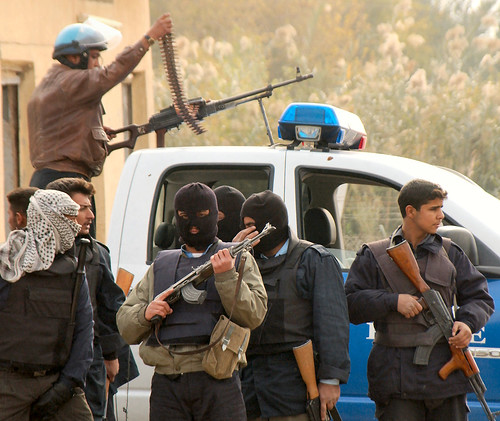
We were collected at my aunts house for my cousins birthday party a few days ago. J. just turned 16 and my aunt invited us for a late lunch and some cake. It was a very small gathering- three cousins- including myself- my parents, and J.’s best friend, who also happened to be a neighbor.
The lunch was quite good- my aunt is possibly one of the best cooks in Baghdad. She makes traditional Iraqi food and for J.’s birthday she had prepared all our favorites- dolma (rice and meat wrapped in grape leaves, onions, peppers, etc.), beryani rice, stuffed chicken, and some salads. The cake was ready-made and it was in the shape of a friendly-looking fish, J.’s father having forgotten she was an Aquarius and not a Pisces when he selected it, “I thought everyone born in February was a Pisces…” He explained when we pointed out his mistake.
When it was time to blow out the candles, the electricity was out and we stood around her in the dark and sang “Happy Birthday” in two different languages. She squeezed her eyes shut briefly to make a wish and then, with a single breath, she blew out the candles. She proceeded to open gifts- bear pajamas, boy band CDs, a sweater with some sparkly things on it, a red and beige book bag… Your typical gifts for a teenager.
The gift that made her happiest, however, was given by her father. After she’d opened up everything, he handed her a small, rather heavy, silvery package. She unwrapped it hastily and gasped with delight, “Baba- it’s lovely!” She smiled as she held it up to the light of the gas lamp to show it off. It was a Swiss Army knife- complete with corkscrew, nail clippers, and a bottle opener.
“You can carry it around in your bag for protection when you go places!” He explained. She smiled and gingerly pulled out the blade, “And look- when the blade is clean, it works as a mirror!” We all oohed and aahed our admiration and T., another cousin, commented she’d get one when the Swiss Army began making them in pink.
I tried to remember what I got on my 16th birthday and I was sure it wasn’t a knife of any sort.
By 8 pm, my parents and J.’s neighbor were gone. They had left me and T., our 24-year-old female cousin, to spend a night. It was 2 am and we had just gotten J.’s little brother into bed. He had eaten more than his share of cake and the sugar had made him wild for a couple of hours.
A friend of mine wrote this
I think it needs to be emphasized in the Western coverage of this matter (including BBC's) that the popular perception of Muslims regarding the cartoons is hugely skewed because of reports/rumors/email forwards that misrepresent the contents of the cartoons. The general perceptions vary between ideas such as the cartoons portraying the Prophet as a pedophile, or being raped by a dog, or being associated with pigs. Some sources of such fabrications have been identified, but most people are not clear on what the cartoons really portray and have a much more offensive and demeaning portrayal in their minds.
A second issue is the perceived double standard in having laws in Europe that protect Jews and their symbols (especially the Holocaust) from ridicule or defame or even questioning and discussion, while Muslims are given the "freedom of speech" line by those same countries.
A third issue of course is the lack of understanding of Muslims of their own history and how the Prophet himself (and God, through the Quran) has responded to ridicule directed at him. The Quran mentions in many places the kinds of ridicule that had been leveled at Muhammad (he was accused of being just a poet- poets usually having been perceived as being inspired by demons, or being a magician, or being a priest- also a concept with different connotations in pre-Islamic Arab society, or being simply mad). The Sira or history of the Prophet also mentions many kinds of abuse and ridicule that the Prophet had endured. My point is that the restraint showed by Muhammad and urged by him unto his companions in the face of such ridicule or abuse should be an example for Muslims today to follow.
Words are words. They should be combated or responded to by words- or by "beautiful forgiveness" as Islam instructs- or as the Quran instructs: if the ignorant ones speak to us, then we say unto them peace be upon you, that is, we calmly and pleasantly ignore them.
The mural maze

Much of Iran's most virulently anti-Israeli public art has been produced using technology from the Jewish state. Robert Tait explains
Wednesday February 8, 2006Guardian Unlimited
Things may change when Iran's biggest-selling newspaper gets round to publishing the results of its planned cartoon contest satirising the Holocaust, but for now the larger-than-life mural lionising Reem Saleh al-Riyashi, a Palestinian female suicide bomber, is as vivid an illustration as any of the Islamic republic's implacable hostility to Israel.Two years ago, al-Riyashi entered the realms of Palestinian martyrdom when she blew herself up, killing four Israelis in the process, at the Erez crossing point in Gaza. Today, motorists and passersby gazing down from Motahari Street, in central Tehran, can contemplate her grimly resolute features as she holds her young son in one hand and a gun in the other.
Next to her portrait, set against a backdrop showing the Jerusalem landmark the Dome of the Rock and two booted feet trampling an Israeli flag, is another giant picture celebrating the actions of a further seven Palestinian women suicide bombers.
On the face of it, the banners are the highly predictable artistic reflection of President Mahmoud Ahmadinejad's recent wave of fervently anti-Zionist rhetoric, in which he called for Israel to be "wiped off the map" and dismissed the Holocaust as a myth. But there is one twist: they have been created with technology made in Israel.
Experts in Iran's printing industry say they are typical of images produced by hi-tech digital printers made by Scitiex Vision, based in Tel Aviv. Printing equipment originating in Israel is commonly used in Iran.
"Those two banners are five metres wide, and no printing company other than Scitex produces that kind of technology," said one Tehran printing company owner, who requested anonymity. "The large-format printing industry is Israeli-led. Their equipment is very reliable. The result is that Israeli-made equipment is sold in Iran, and a lot of the anti-Israeli and anti-American propaganda you see here is made by this kind of equipment.
Worlds apart
sraelis have always been horrified at the idea of parallels between their country, a democracy risen from the ashes of genocide, and the racist system that ruled the old South Africa. Yet even within Israel itself, accusations persist that the web of controls affecting every aspect of Palestinian life bears a disturbing resemblance to apartheid. After four years reporting from Jerusalem and more than a decade from Johannesburg before that, the Guardian's award-winning Middle East correspondent Chris McGreal is exceptionally well placed to assess this explosive comparison. Here we publish the first part of his two-day special report
Chris McGreal Monday February 6, 2006Guardian
Read the second part of Chris McGreal's reportSaid Rhateb was born in 1972, five years after Israeli soldiers fought their way through East Jerusalem and claimed his family's dry, rock-strewn plot as part of what the Jewish state proclaimed its "eternal and indivisible capital". The bureaucrats followed in the army's footsteps, registering and measuring Israel's largest annexation of territory since its victory over the Arab armies in the 1948 war of independence. They cast an eye over the Rhateb family's village of Beit Hanina and its lands, a short drive from the biblical city on the hill, and decided the outer limits of this new Jerusalem. The Israelis drew a line on a map - a new city boundary - between Beit Hanina's lands and most of its homes. The olive groves and orchards were to be part of Jerusalem; the village was to remain in the West Bank.
The population was not so neatly divided. Arabs in the area were registered as living in the village - even those, like Rhateb's parents, whose homes were inside what was now defined as Jerusalem. In time, the Israelis gave the Rhatebs identity cards that classified them as residents of the West Bank, under military occupation. When Said Rhateb was born, he too was listed as living outside the city's boundaries. His parents thought little of it as they moved freely across the invisible line drawn by the Israelis, shopping and praying inside the walls of Jerusalem's Old City.
Four decades later, the increasingly complex world of Israel's system of classification deems Said Rhateb to be a resident of the West Bank - somewhere he has never lived - and an illegal alien for living in the home in which he was born, inside the Jerusalem boundary. Jerusalem's council forces Rhateb to pay substantial property taxes on his house but that does not give him the right to live in it, and he is periodically arrested for doing so. Rhateb's children have been thrown out of their Jerusalem school, he cannot register a car in his name - or rather he can, but only one with Palestinian number plates, which means he cannot drive it to his home because only Israeli-registered cars are allowed within Jerusalem - and he needs a pass to visit the centre of the city. The army grants him about four a year.
We have lost our voice
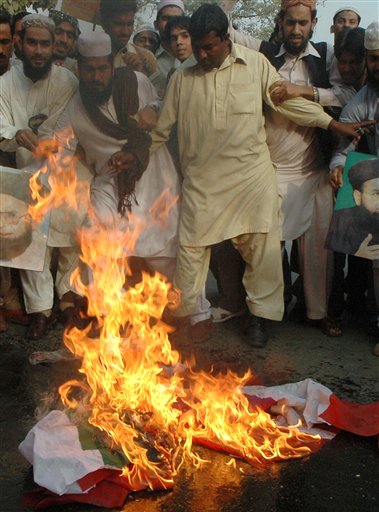
Moderate Muslims, from Denmark to the Middle East, are caught in the vice of a manufactured conflict
Tabish Khair in Aarhus Tuesday February 7, 2006Guardian
When I first saw them, I was struck by their crudeness. Surely Jyllands-Posten could have hired better artists. And surely cartoonists and editors ought to be able to spot the difference between Indian turbans and Arab ones. In some ways, that was the essence of the problem to begin with. It is this patronising tendency - stronger in Denmark than in countries such as Britain or Canada - that decided the course of the controversy and coloured the Danish reaction.One could see that the matter would take a turn for the worse when, late last year, the Danish prime minister refused to meet a group of Arab diplomats who wished to register their protest. In most other countries they would have been received, their protest accepted. The government would have expressed "regret" and told them it could not put pressure on any media outlet as a matter of law and policy. In their turn, having done their Muslim duty, these diplomats might have helped lessen the reaction in their respective countries. By not meeting them, the prime minister silenced all moderate Muslims just as effectively as they would be later silenced by militant Muslims around the world.
Like many other moderate Muslims, I too have been silent on these cartoons of the prophet Muhammad and the ensuing protests. Not because I do not have anything to say, but because there is no space left for me either in Denmark or in many Muslim countries.
Broke Back to the Future
 Amazing re-edit of the Back to the Future series into a film preview depicting a gay love relationship between Doc and McFly.
Click here.
Amazing re-edit of the Back to the Future series into a film preview depicting a gay love relationship between Doc and McFly.
Click here.
Brain food
As new research published today reveals a link between poor diet and mental ill health, Fran Gorman says it's time for the government to act Rise in mental illness linked to unhealthy diets, say studies
Fran Gorman Monday January 16, 2006SocietyGuardian.co.uk
There appears to be no respite in the pace or impact of the growing burden of mental ill health on individuals and the nation as a whole. One in four people is likely to experience a mental illness at some point in their life, and the costs of mental ill health to the UK economy are now approaching £100bn a year.Mental health problems are believed to be the result of a combination of factors, including age, genetics and environmental factors. One of the most obvious, yet under-recognised factors in the development of major trends in mental health is the role of nutrition.
But the body of evidence linking diet and mental health is growing at a rapid pace. As well as its impact on short and long-term mental health, the evidence indicates that food could play an important contributing role in the development, management and prevention of specific mental health problems such as depression, schizophrenia, attention deficit hyperactivity disorder, and Alzheimer's disease.
The increasing incidence of mental ill health echoes changes in food production in the UK. The last 50 years have witnessed significant changes to the way food is produced and manufactured. The proliferation of industrialised farming has introduced higher levels and different types of fat into our diet.
Thursday, February 16, 2006
Iran and Israel will be kings of the Middle East jungle
The US occupation of Iraq has turned its neighbour into a new regional power. But the contagion is likely to spread far wider
David Hirst
Friday January 13, 2006
Guardian
In March 2003, before US troops reached Baghdad, Middle East scholar Volker Perthes wrote that while the risks of this "illegitimate" war were enormous, those of "a US failure to stabilise postwar Iraq would be even higher". With those words looking increasingly prophetic, no one, in picturing the implications of such failure, is now more lurid than the Bush administration. The direness of the prospect has become its strongest argument for "staying the course", but for others it is already a given, amounting to "the greatest strategic disaster in US history", in the words of the retired US general William Odom.
If so, what will this disaster look like? In scale, it will surely be at least commensurate with the vast ambitions that came with the invasion in the first place, Iraq being cast as the platform for reshaping the entire Middle East.
A general US retreat from the region, with troop withdrawal at its core, is no doubt a prerequisite for, and yardstick of, the emergence of a healthy, self-reliant new Middle Eastern order. But, with the kind of ignominious scuttle from Iraq that failure would presumably entail, the region won't just revert to the status quo ante. Instead of Iraq becoming a beacon of all good things it will become the single most noxious wellspring of all the bad ones the invasion was supposed to extinguish - and new ones to boot.
Read more...
Women on hijab
 Very entertaining, at some points wasn't even sure if it was a satire. But it's what may be women's various understanding of what it means to them to be hijabi. I also like it because it's Malaysian or Indonesian muslims which are always forgotten these days. The vast majority of Muslims are not Arabs.
Click here...
Very entertaining, at some points wasn't even sure if it was a satire. But it's what may be women's various understanding of what it means to them to be hijabi. I also like it because it's Malaysian or Indonesian muslims which are always forgotten these days. The vast majority of Muslims are not Arabs.
Click here...
EGYPT'S FIRST LADIES

Subscribe to:
Posts (Atom)
Subscribe To


 Posts
All Comments
Posts
All Comments
